
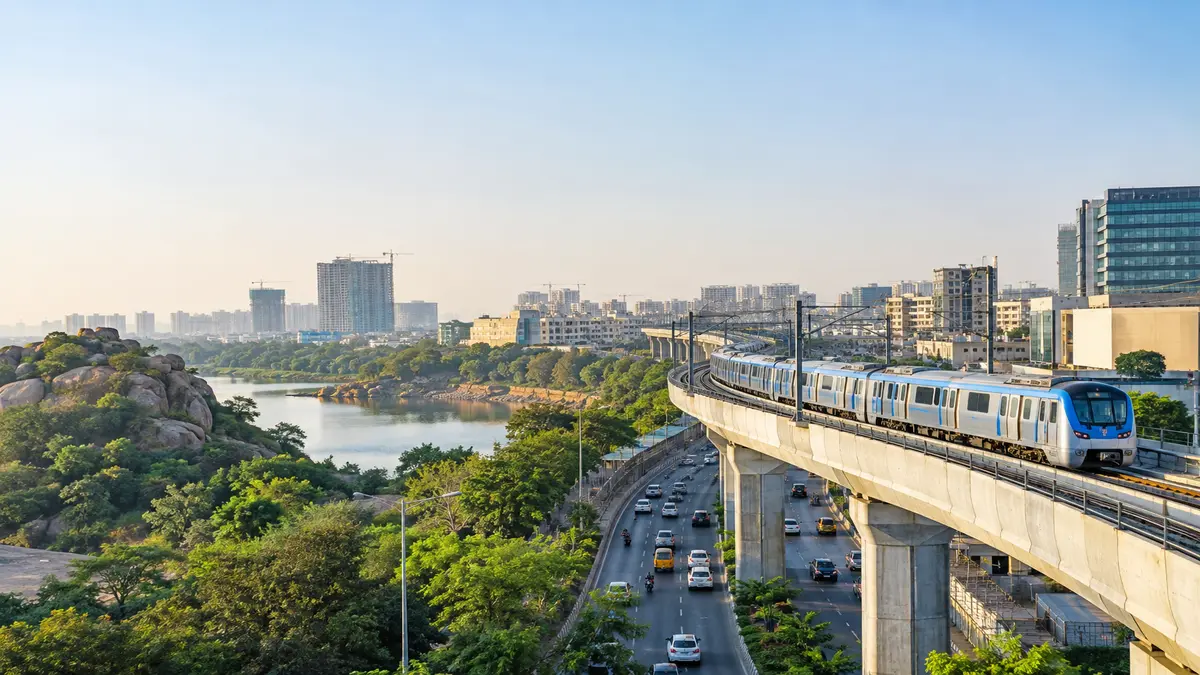
In a major infrastructure overhaul for central Hyderabad, the Greater Hyderabad Municipal Corporation (GHMC) has approved a revised ₹1,090-crore elevated corridor around Kasu Brahmananda Reddy (KBR) Park. The proposed 4.3-km, six-lane continuous structure replaces an earlier blueprint of separate flyovers, underpasses, and grade separators under the Hyderabad City Innovative and Transformative Infrastructure (H-CITI) programme.
| Detail | Project Information |
|---|---|
| Proposed Corridor Length | 4.3 km |
| Corridor Configuration | Six lanes, bidirectional |
| Reported Total Project Cost | ₹1,090 crore |
| Package 1 Estimate | ₹580 crore (Jubilee Hills Check Post to Mugdha Junction) |
| Package 2 Estimate | ₹510 crore (Extension to Muffakham Jah College & Road No. 1 ramp) |
| Execution Mode | Engineering, Procurement, and Construction (EPC) |
| Standing Committee Approval | October 3, 2026 |
GHMC Clears Continuous 4.3-Km Corridor Across Two Packages
The revised H-CITI infrastructure plan was officially approved by the GHMC Standing Committee on October 3, 2026. Following the clearance, GHMC Commissioner RV Karnan conducted an on-site inspection around the KBR Park perimeter with senior municipal engineering officials on October 5.
The project will be executed in EPC mode across two distinct packages totaling ₹1,090 crore. Package 1 is budgeted at ₹580 crore and spans from Jubilee Hills Check Post Junction to Mugdha Junction. Package 2, estimated at ₹510 crore, extends the alignment towards Muffakham Jah College and incorporates a dedicated access ramp connecting to Banjara Hills Road No. 1.
Overall, the continuous elevated corridor is designed to run from Jubilee Hills Check Post to NFCL Junction in Punjagutta, streamlining traffic through a single elevated corridor instead of multiple disjointed ground-level grade separators.
Impact on Jubilee Hills and Banjara Hills Commuters
Daily commuters moving across Jubilee Hills, Punjagutta, and Banjara Hills are set to experience shifts in traffic flow once construction commences and final alignments are established. The corridor aims to ease congestion across five major junctions surrounding the park, providing uninterrupted bidirectional movement for city motorists.
For residents, commercial establishments, and property owners along the corridor, the revised elevated alignment brings changes to local access routes and right-of-way considerations. GHMC indicated that the elevated corridor approach significantly reduces the need to acquire high-value private land in prime commercial zones compared to ground-level road widening.
Property owners tracking local infrastructure alignments and title records in adjacent residential sectors can review documentation protocols through the Bhu Bharati Portal to monitor right-of-way notifications as project surveys progress.
Five Major Junctions Transformed Across Central Hyderabad
The project covers one of Hyderabad’s most vital commercial and transit routes, connecting the bustling Jubilee Hills Check Post area with the Punjagutta and NFCL commercial side. By bridging five heavy-traffic junctions in a unified elevated alignment, the project seeks to segregate through-traffic from local vehicular movements.
GHMC officials highlighted that the continuous elevated corridor design is structured specifically to minimize tree felling around the perimeter of KBR Park, preserving the sensitive green cover while still delivering high-capacity roadway infrastructure.
“Proposals for flyovers and underpasses were reassessed after the one-way traffic system around KBR Park received a good response, and the redesign is intended to overcome legal delays linked to tree-felling litigation.”
From Fragmented Flyovers to the H-CITI Redesign
Under earlier iterations of the H-CITI programme, the civic body had planned a series of fragmented grade separators, separate flyovers, and underpasses around the KBR Park junction network. However, those initial construction plans stalled due to prolonged litigation surrounding environmental and tree-felling permissions.
The recent introduction and positive operational feedback from the one-way traffic trial around KBR Park prompted authorities to rethink the entire design. The consolidated six-lane elevated corridor emerged as a streamlined alternative that addresses traffic demands while circumventing the specific environmental constraints that previously halted ground construction.
Real estate buyers assessing new residential or commercial projects in surrounding micro-markets should ensure that developments comply with statutory approvals outlined under Telangana RERA, particularly when transit corridors alter neighborhood access.
Tender Execution and Next Steps for Construction
While the GHMC Standing Committee has granted its formal approval for the ₹1,090-crore proposal, the project must complete subsequent administrative and technical milestones before work begins on the ground. The official report does not yet specify a ground-breaking date or a definitive completion deadline.
Stakeholders must track the publication of EPC tender documents, detailed engineering blueprints, updated cost evaluations, and the rollout of local traffic diversion schemes before heavy civil works begin.
Reality Check
Although the elevated corridor reduces private land acquisition and seeks to bypass previous tree-felling disputes, the reported travel and environmental benefits remain proposed engineering projections. The actual impact on traffic flow and urban greenery will depend heavily on detailed design execution, site management, and timely approvals from statutory bodies.
Analysis
Consolidating multiple separate grade separators into a single 4.3-km elevated corridor simplifies construction oversight and reduces ground-level bottlenecks. However, executing a major six-lane elevated structure across active commercial hubs like Jubilee Hills and Banjara Hills will require extensive traffic diversion management to avoid severe transit disruption during the build phase.
Frequently Asked Questions
What is GHMC proposing around KBR Park?
GHMC has proposed a 4.3-km, six-lane continuous elevated corridor under the H-CITI programme to replace earlier plans for separate flyovers, underpasses, and grade separators around KBR Park.
What is the reported project cost?
The total estimated cost is ₹1,090 crore, split across two execution packages under EPC mode.
Where will the two packages run?
Package 1 (₹580 crore) covers the stretch from Jubilee Hills Check Post Junction to Mugdha Junction. Package 2 (₹510 crore) extends the corridor to Muffakham Jah College with a ramp to Banjara Hills Road No. 1, connecting toward NFCL Junction in Punjagutta.
Why was the earlier flyover plan reassessed?
The redesign was initiated following the positive response to the one-way traffic trial around KBR Park and to overcome legal delays caused by pending litigation over tree-felling permissions.
When will construction begin?
The official report confirms Standing Committee approval on October 3, 2026, but does not provide an official construction start date or project completion timeline.
Stay Ahead on Hyderabad Real Estate
Get daily property news, price trends and verified listings.
Follow us on WhatsApp or download the BigProperty App for instant alerts.

