
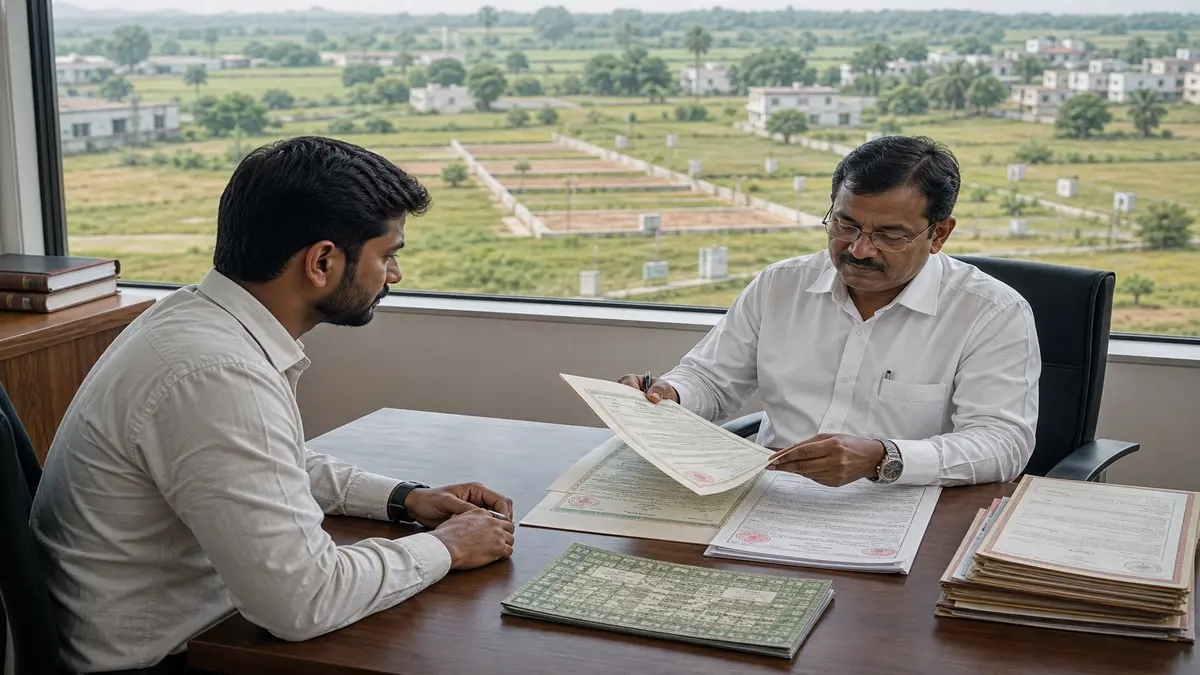
You stand at the Sub-Registrar Office in Hyderabad, ready to close the deal on your dream plot. Suddenly, the officer rejects your file because the name on your Pattadar Passbook does not match your Aadhaar card. This is a painful scenario many property buyers face when they ignore proper documentation. Sorting out land records at the last minute costs time, money, and immense mental stress.
Gathering the correct registration documents is the single most critical step in securing your real estate investment. According to 2026 data from the revenue department, nearly 30% of property registrations face delays simply due to missing link documents or outdated entries on the Bhu Bharati Portal. A single missing survey number can completely halt your transaction. You must approach this process with strict attention to detail.
This complete guide explains the exact registration paperwork you need for property transactions in Telangana, how to calculate stamp duty fees, and the correct steps for digital submission.
| Detail | Info |
|---|---|
| Governing Body | Registration and Stamps Department, Telangana |
| Official Portal | bhubharati.telangana.gov.in |
| Applicable State | Telangana |
| Act Reference | Registration Act 1908 & Telangana Rights in Land Act 2020 |
| Application Fee | Starts at ₹1000 (varies by property value) |
| Processing Time | 1 to 3 working days |
| Helpline / Contact | 1800 599 4788 |
| Last Updated | 2026 |
“A property is only as secure as the paperwork that proves you own it. Never compromise on a 30-year link document search.”
What are Registration Documents in Telangana?
Registration documents are legal papers submitted to the Sub-Registrar Office to officially transfer property ownership from a seller to a buyer. These documents include the sale deed, title proofs, identity cards, and encumbrance certificates required under the Registration Act. Proper registration ensures the buyer receives absolute legal rights over the specific property.
The government maintains a public registry of all land transactions. When you register a property, you make a public declaration of your ownership. This legal framework prevents unauthorized individuals from claiming rights over your land. The state collects stamp duty revenue during this process, which acts as official proof of the transaction.
Telangana has modernized this process significantly by 2026. The integration of local Sub-Registrar Offices with the central digital land records system means physical paperwork is verified against online databases. If your physical papers do not match the digital entries, the registration will freeze immediately.
Core Objectives and Buyer Benefits
Understanding the purpose behind these legal formalities helps you navigate the system better. The government enforces strict document verification for several critical reasons.
- To create a permanent public record of property ownership and prevent fraudulent double sales.
- To ensure the state collects the appropriate stamp duty and transfer taxes.
- To verify that the seller has clear, unencumbered rights to transfer the asset.
- To update the revenue village records promptly after a successful transaction.
- To prevent benami transactions by mandating biometric authentication for all parties involved.
As a buyer or landowner, securing correct paperwork offers immense protection. The benefits extend far beyond just holding a title deed.
- You gain absolute legal protection against third-party claims or civil disputes.
- You can easily apply for home loans, agricultural credit, or mortgage-backed funding from nationalized banks.
- You can smoothly apply for Bhu Bharati Mutation to get the Pattadar Passbook in your name.
- You secure the legal right to partition the land among your heirs in the future.
- You establish a clear chain of title that will make selling the property much easier later.
Who Needs to Provide Registration Documents?
Every real estate transaction involves multiple stakeholders. Each party has specific documentation responsibilities to complete the transfer.
| Category | Applicable | When Required |
|---|---|---|
| Property Buyers | Yes | Must provide ID, PAN, and payment proofs. |
| Property Sellers | Yes | Must provide original title deeds and link documents. |
| Legal Heirs | Yes | Required during succession, partition, or gift deed registration. |
| NRI Investors | Yes | Must provide passport copies and GPA if acting through a representative. |
| Banks & Lenders | Yes | Required to register a mortgage deed when issuing a property loan. |
Essential Registration Documents Required
You cannot walk into a Sub-Registrar Office with just a printed sale agreement. A successful transaction requires a comprehensive bundle of primary and secondary papers. Agricultural and non-agricultural properties have slightly different requirements.
| Document | Who Submits |
|---|---|
| Original Draft Sale Deed | Buyer and Seller jointly |
| Previous Original Title Deed | Seller |
| Link Documents (Past 30 Years) | Seller |
| Encumbrance Certificate (EC) | Seller |
| Pattadar Passbook (For Agriculture) | Seller |
| Recent Pahani / Adangal Copy | Seller |
| Latest Property Tax Receipt | Seller |
| Aadhaar & PAN Cards | Buyer, Seller, and Witnesses |
| Challan for Stamp Duty Payment | Buyer |
| Passport Size Photographs | Buyer, Seller, and Witnesses |
Pro Tip
Always print your draft sale deed on non-judicial stamp paper of appropriate value. Ensure that the boundaries mentioned in the deed perfectly match the physical boundaries and the official layout plan. A single directional mistake will require a rectification deed later.
Understanding the Fee Structure and Stamp Duty Charges
Registering property requires substantial financial planning. The Telangana government revises land market values periodically. You must pay stamp duty based on either the registered sale consideration or the official market value, whichever is higher.
| Service | Fee (Telangana) | Comparison State (AP) |
|---|---|---|
| Stamp Duty (Urban Areas) | 5.5% of market value | 5.0% of market value |
| Transfer Duty | 1.5% of market value | 1.5% of market value |
| Registration Fee | 0.5% of market value | 1.0% of market value |
| Mutation Application Fee | ₹2500 fixed | ₹1000 – ₹2000 approx |
| Encumbrance Certificate (Online) | Free to view | Free to view |
If you are registering a Gift Deed in favor of blood relatives (like parents, children, or spouse), the stamp duty is significantly lower. The government charges a nominal stamp duty along with standard registration fees for family settlements. Always consult a revenue expert to calculate exact fees before purchasing challans.
Step-by-Step Property Registration Process
The days of waiting in long physical queues are mostly over. Telangana uses a hybrid system where document generation and slot booking happen online, followed by a mandatory physical visit for biometric verification.
Draft the Legal Deed
Engage a certified document writer or legal expert to draft your sale deed. Ensure all property schedules, boundaries, and payment details are accurately mentioned.
Generate Challan and Pay Fees
Log into the official registration portal to calculate your stamp duty. Generate a digital challan and pay the required fees using net banking or a designated bank branch.
Book a Registration Slot
Use the Public Data Entry (PDE) system to upload brief details of your transaction. Select an available date and time slot at your jurisdictional Sub-Registrar Office.
Visit the Sub-Registrar Office
Arrive at the office 15 minutes before your booked slot. Bring the buyer, the seller, and at least two reliable witnesses with original ID proofs.
Present the Documents
Submit your printed sale deed, original link documents, and fee payment receipts to the processing officer for initial legal scrutiny.
Complete Biometric Authentication
The officer will capture photographs and thumb impressions of the buyer, seller, and witnesses. This biometric data is permanently attached to the digital deed.
Collect the Registered Document
Once approved, the Sub-Registrar signs and seals the document. You can collect the original registered deed from the counter after scanning is complete.
Common Errors and How to Correct Them
Minor clerical mistakes in registration documents cause major legal headaches later. Identifying these errors early saves you from having to register a separate rectification deed.
| Common Error | How to Correct It | Authority Involved |
|---|---|---|
| Spelling Mismatch in Names | Execute a registered Rectification Deed | Sub-Registrar Office |
| Wrong Survey Number Listed | Provide original Pahani and register a Rectification Deed | Sub-Registrar & Tahsildar |
| Missing Link Documents | File an FIR for lost documents and publish a paper notification | Police & Revenue Court |
| Aadhaar Verification Failure | Update biometrics at Aadhaar center before booking slot | UIDAI Center |
| Boundary Extent Mismatch | Request a physical survey before drafting the deed | Mandal Surveyor |
Watch Out
The most commonly ignored issue is failing to verify the seller’s name in the latest Pahani. Even if the seller holds a registered deed, if their name was never updated in the revenue records via mutation, the digital portal will block the new registration.
Landowner and Property Buyer Rights
The legal framework protects citizens from bureaucratic harassment. Knowing your rights ensures a smoother transaction at the revenue office.
- Right to Timely Service: Under the state citizen charter, a properly submitted document must be registered and returned on the same day.
- Right to Reject Under-valuation: If the official arbitrarily increases the property valuation, you have the right to appeal to the District Registrar.
- Right to Digital Copies: You are entitled to receive a digitally signed copy of your Pahani download or Encumbrance Certificate online.
- Right to Return of Originals: The Sub-Registrar must return all your original link documents after scanning them for their records.
- Right to Appeal Mutation Rejection: If your subsequent mutation request is denied, you can file an appeal with the Revenue Divisional Officer (RDO) within 30 days.
5 Things Every Buyer Must Know Before Registration
- Check the 1-B Register
Always verify the seller’s name in the digital 1-B register before buying farm land.
- Verify Prohibited Lands
Ensure the survey number is not listed in the Section 22-A prohibited properties list.
- Clear Previous Mortgages
Check the Encumbrance Certificate for any unreleased bank loans on the property.
- Match Aadhaar Details
The seller’s name on the deed must perfectly match their Aadhaar card data.
- Pay Fees Online
Never pay cash at the office. Generate official challans for all state duties.
Did You Know?
In 2026, Telangana fully transitioned its legacy Dharani system to the new Bhu Bharati portal. This upgrade introduced AI-based facial recognition for landowners, significantly reducing impersonation fraud during property registrations.
Reality Check: What the Digital Portal Cannot Fix For You
Digital land records are excellent tools, but they are not flawless. Many landowners mistakenly believe that a clear online portal guarantees a perfect physical property. This is a dangerous assumption.
First, the digital system suffers from legacy data migration errors. When physical ledgers were digitized years ago, data entry operators made thousands of spelling mistakes and acreage errors. If your grandfather’s name was entered wrongly back then, the current portal will stubbornly reflect that error until you file a formal grievance.
Second, civil court stays freeze the digital process entirely. If a distant relative files a partition suit in a civil court and obtains an injunction, the property is locked on the state portal. You cannot bypass a court order using online slot bookings. Resolving this requires extensive legal battling, not just a simple portal login.
Finally, field-level verification is absolutely mandatory. The online map might show a perfect rectangular plot of one acre. However, on the ground, a neighboring farmer might have encroached on 10 guntas of your land. The digital system cannot verify physical boundary stones. You must hire a licensed surveyor to measure the land physically before paying the final sale amount.
Watch Out
The single most critical mistake buyers make is relying entirely on digital printouts. An online encumbrance certificate does not guarantee physical possession. You must visit the site, speak to the neighbors, and verify physical occupation.
Comparison: Agricultural vs Non-Agricultural Registration
The rules for registering farm land differ significantly from those for registering open plots or apartments in urban areas. Understanding this difference is vital.
Property Type Registration Comparison
| Factor | Agricultural Land | Non-Agricultural Property |
|---|---|---|
| Primary Authority | Tahsildar (Joint Sub-Registrar) | SRO (Sub-Registrar Office) |
| Mandatory Document | Pattadar Passbook | Approved Layout Plan / Building Plan |
| Mutation Process | Automatic via portal | Manual application via local municipality |
| Applicable Portal | Bhu Bharati | IGRS Telangana |
| Buyer Restriction | Must hold agricultural status in some cases | No specific status required |
Expert Tip
When buying agricultural land, always ask for the Faisal Patti (village revenue account) alongside the regular Pahani. The Faisal Patti shows the exact history of how the seller originally acquired the land, giving you deeper legal clarity than a standard digital extract.
Official Land Records Resources
Always use the official state portals to verify your property documents. Fraudulent websites often mimic state portals to steal application fees.
| Resource | Purpose | URL (plain text) |
|---|---|---|
| Bhu Bharati Portal | Telangana Land Record Search | bhubharati.telangana.gov.in |
| IGRS Telangana | Registration Document Tracking | registration.telangana.gov.in |
| Meebhoomi Portal | AP Land Record Verification | meebhoomi.ap.gov.in |
| Bhoomi Portal | Karnataka Land Record Search | landrecords.karnataka.gov.in |
Frequently Asked Questions
What are the primary registration documents needed in Telangana?
The primary registration documents include the original draft sale deed, previous link documents for the last 30 years, an Encumbrance Certificate, ID proofs like Aadhaar and PAN, and the Pattadar Passbook if you are registering agricultural land.
How do I book a slot for property registration online?
You can book a slot by logging into the state registration portal or Bhu Bharati. Fill in the transaction details, generate the stamp duty challan, pay the fees online, and select an available date at your local Sub-Registrar Office.
What happens if a link document is missing?
If a link document is missing, you must file a First Information Report (FIR) with the local police. Afterwards, you publish a public notice in two local newspapers. The police will issue a non-traceable certificate, which you submit during registration.
Can I register a property without an Encumbrance Certificate?
No. The Sub-Registrar requires an Encumbrance Certificate to verify that the property has no pending loans, mortgages, or legal disputes. You can easily download this certificate from the official portal before drafting your sale deed.
Is physical presence mandatory for registration?
Yes, physical presence is strictly mandatory. The buyer, the seller, and two witnesses must visit the Sub-Registrar Office on the booked date to provide live photographs and biometric thumb impressions to prevent identity fraud.
Who pays the stamp duty during registration?
By standard legal practice, the property buyer pays the stamp duty, transfer duty, and registration fees. However, both parties can mutually agree to split the costs if clearly stated in their prior sale agreement.
Need Help with a Land Records Issue
Whether you are checking a Pahani entry, tracking a mutation application, or verifying a patta — our team can guide you to the right resource.
Chat with us on WhatsApp or email us at [email protected]
Download the BigProperty App to check land record status, track mutation applications, and get property alerts in Hyderabad.

