
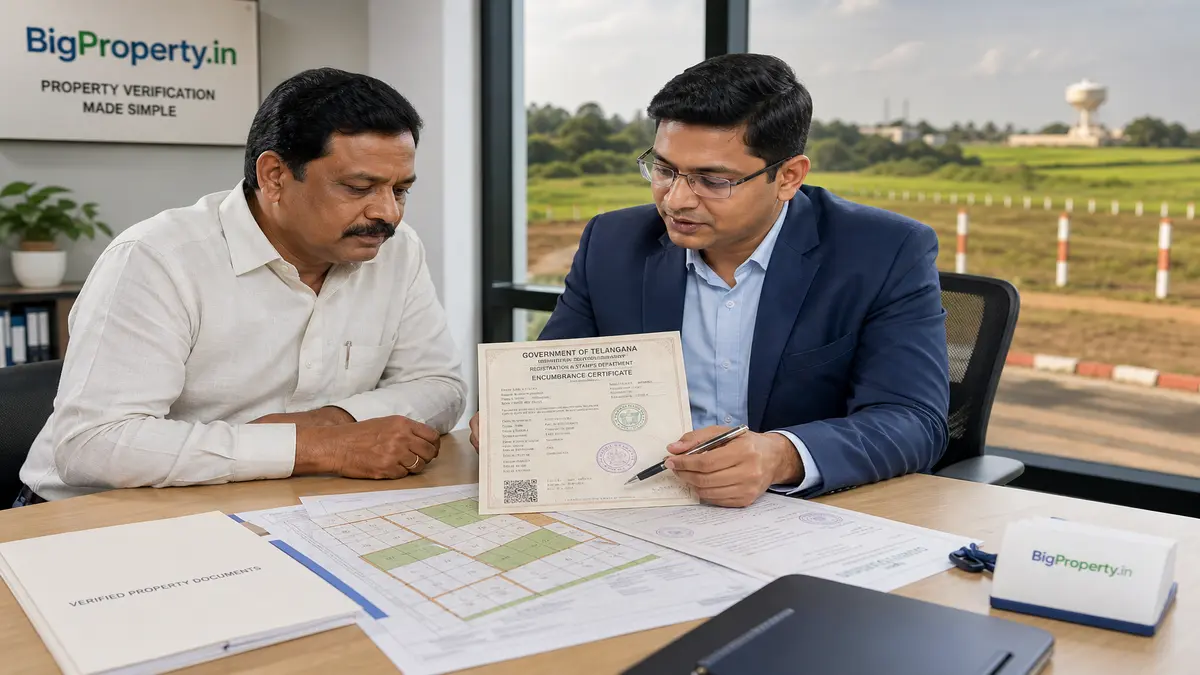
Imagine paying a heavy token advance for a premium plot in Hyderabad, only to discover the property is already mortgaged to a private lender. This nightmare happens frequently when buyers skip the basic due diligence of verifying government records. Without an Encumbrance Certificate Telangana, you are essentially buying real estate blindfolded. The Encumbrance Certificate (EC) is the single most critical document that proves a property is free from legal dues, ongoing mortgages, and ownership disputes.
Official state revenue data shows that nearly 30% of civil disputes in property transactions occur simply because buyers fail to verify past registration records. A clear property title ensures your hard-earned money is safe and your future ownership remains legally unchallenged. Whether you are applying for a home loan, inheriting ancestral land, or purchasing a new flat, knowing the exact registration history of the asset is non-negotiable. While portals like Dharani handle agricultural records, the registration history requires a formal SRO check.
This comprehensive guide explains exactly how to access, read, and verify your property’s legal status through the official government platforms in 2026. We will walk you through the exact application steps, document requirements, fee structures, and the common pitfalls landowners face.
| Detail | Info |
|---|---|
| Governing Body | Inspector General of Registration and Stamps (IGRS), Telangana |
| Official Portal | registration.telangana.gov.in |
| Applicable State | Telangana |
| Act Reference | Registration Act, 1908 |
| Application Fee | ₹200 to ₹500 (varies by search duration) |
| Processing Time | Instant (Online) / 1 to 3 Days (Offline) |
| Helpline / Contact | 1800 599 4788 (IGRS Toll-Free) |
| Last Updated | 2026 |
“A clear land record proves who owns the property, but only a clear Encumbrance Certificate proves who has the absolute legal right to sell it without liabilities.”
What is an Encumbrance Certificate (EC)?
An Encumbrance Certificate (EC) is an official legal document issued by the Sub-Registrar Office (SRO) that records all registered transactions, mortgages, and liabilities tied to a specific property over a designated period. It serves as primary evidence of a free and marketable title.
When you buy property anywhere in Telangana, you need absolute certainty regarding its complete registration history. The word “encumbrance” literally translates to a burden or a financial charge on the asset. If a previous owner took a bank loan against the house, that active loan is an encumbrance. If the property was legally gifted, partitioned among family members, or leased for a long tenure through a registered deed, every single one of those actions is recorded as an encumbrance entry in the government ledgers.
The Registration Act of 1908 strictly governs the issuance and maintenance of this document. In Telangana, the Inspector General of Registration and Stamps (IGRS) manages the centralized digital database of these certificates. You can track basic agricultural land ownership details on the official state revenue portals, but the actual transaction history, sale deeds, and mortgage details require an EC from the IGRS portal.
The government issues this certificate in two specific formats. Form 15 is issued when there are actual recorded transactions, sales, or mortgages on the property during the period you searched. Form 16, widely known as a Nil Encumbrance Certificate (NEC), is issued when absolutely no registered transactions took place during that specific time frame. Both forms hold equal legal weight in a court of law.
Objectives and Benefits of Obtaining an EC
The primary objective of this certificate is to protect buyers from property fraud. Before you finalize any deal, you must understand exactly how this document secures your investment.
- Provides a chronological history of property ownership changes.
- Reveals hidden financial liabilities, including active bank mortgages.
- Confirms whether the seller holds genuine legal authority to transfer the title.
- Acts as mandatory proof for property registration at the Sub-Registrar Office.
- Helps prevent double-registration scams where the same plot is sold to multiple buyers.
For landowners and property buyers, the practical benefits extend far beyond simple record verification.
- Home Loan Approvals: No bank or housing finance company will sanction a loan without a 13-year or 30-year EC.
- Mutation Processing: Revenue officers require this document to process a Bhu Bharati Mutation after a sale.
- Legal Inheritance: It proves that the deceased owner did not secretly pledge the property before their passing.
- Project Verification: It helps verify if a builder has mortgaged the project land before you check the Telangana RERA Approved Projects list.
Who Needs an Encumbrance Certificate?
Various parties require this document at different stages of property ownership and transfer. If you fall into any of these categories, applying for an EC should be your priority.
| Category | Applicable | When Required |
|---|---|---|
| Property Buyers | Yes | Before paying token advance and before final sale deed registration. |
| Property Sellers | Yes | To prove to potential buyers that the title is absolutely clear and marketable. |
| Banks & Lenders | Yes | Before sanctioning home loans or mortgages against the property. |
| Legal Heirs | Yes | When transferring inherited property to ensure no pending debts exist. |
| NRIs | Yes | To remotely monitor their Indian properties for fraudulent registrations. |
Documents Required for EC Application
Applying for this certificate is straightforward, provided you have the correct reference details. Unlike complex revenue applications, an EC search relies purely on previous registration data.
| Document / Detail | Who Submits |
|---|---|
| Previous Sale Deed Number | Applicant / Property Owner |
| Property Schedule (Boundaries) | Applicant |
| Survey Number / Plot Number | Applicant |
| Village and Mandal Name | Applicant |
| Aadhaar Card Copy | Applicant (for offline SRO visits) |
| Registered Link Documents | Applicant (if checking deep history) |
Pro Tip
If you do not have the document number, you can still search the IGRS portal using the exact survey number, flat number, or house number. However, searching by a previous sale deed document number yields the fastest and most accurate results.
Fees and Charges for Telangana EC
The fee structure for obtaining this certificate is nominal and depends entirely on how many years of history you wish to search. The government charges a base fee for the first year and an incremental fee for every subsequent year.
| Service | Fee (Telangana) | Comparison State (AP) |
|---|---|---|
| Search for 1st Year | ₹200 | ₹200 |
| Every Additional Year | ₹25 to ₹50 | ₹30 |
| Fast Track / SRO Priority | Varies by MeeSeva center | Varies by AP Online |
| Online Download (Post 1983) | Free for viewing basic data | Free for viewing basic data |
How to Access and Download EC Online
The Telangana government has digitized all property registration records dating back to January 1, 1983. If your property transaction happened after this date, you can access the certificate online without visiting any government office. Follow these precise steps.
Visit the IGRS Portal
Open the official IGRS Telangana website on your computer. Look for the ‘Online Services’ section prominently displayed on the homepage.
Select Encumbrance Search
Click on the ‘Encumbrance Certificate’ link. The system will prompt you to read a disclaimer regarding the data accuracy of records prior to 1983.
Choose Search Criteria
Select your preferred search method. You can search by ‘Document Number’, ‘Layout Details’, or ‘Property Details’ such as survey number and village name.
Enter Property Details
Input the exact SRO name, document year, and document number. If using the property details option, enter the district, mandal, and specific survey boundaries.
Submit and View Output
Click submit to generate the search results. The portal will display all registered transactions in chronological order on your screen.
Download the Certificate
Select all the relevant entries you wish to include. Click the final generate button to download your official Form 15 or Form 16 in PDF format.
Step-by-Step Process for Offline Application
If you require records registered before January 1, 1983, or if you need a physically signed and stamped certificate for court purposes, you must apply offline. Digital portals do not hold complete manual ledger data from the early decades.
Prepare Form 22
Download or collect Form 22 (Application for Encumbrance Certificate) from your local MeeSeva center or Sub-Registrar Office.
Fill Property Schedules
Carefully fill in the property boundaries, exact village name, mandal, and the specific time period (number of years) you want the SRO to search.
Submit at MeeSeva or SRO
Submit the completed application form along with a copy of your Aadhaar card and the previous property sale deed.
Pay the Required Fee
Pay the search fee based on the number of years requested. Collect your application receipt containing the unique transaction ID.
Collect the Certificate
The SRO staff will manually search the physical ledgers. Return to the office after 2 to 3 working days to collect your physically signed certificate.
Common Errors and Corrections
Even official government records contain human errors. A minor spelling mistake in your survey number can completely derail a future property sale. It is crucial to identify and fix these issues immediately.
| Common Error | How to Correct It | Authority Involved |
|---|---|---|
| Incorrect Survey Number | Execute a Rectification Deed with the seller. | Sub-Registrar Office |
| Missing Recent Transaction | Submit manual application with receipt proof. | SRO / IGRS Helpdesk |
| Wrong Owner Name Spelling | Register a Rectification Deed modifying the name. | Sub-Registrar Office |
| Old Mortgage Still Showing | Obtain No Objection Certificate (NOC) from the bank. | Bank & SRO |
Watch Out
The most commonly ignored issue is an uncleared bank mortgage. Even if you have paid off your home loan completely, the EC will still show the property as mortgaged until you physically register a ‘Deed of Receipt’ or mortgage discharge document at the SRO.
Landowner and Buyer Rights
Understanding your statutory rights empowers you to navigate the revenue and registration systems without intimidation. The law provides clear protections for property buyers.
- Right to Information: Under Section 57 of the Registration Act, any citizen has the absolute right to inspect public property records and obtain an EC by paying the prescribed fee.
- Right to Digital Records: You hold the right to download basic post-1983 encumbrance data freely from the official portal without paying bribes or agent fees.
- Right to Rectification: If the SRO makes a clerical error during registration, you have the right to request a correction without paying massive stamp duties again.
- Right to Title Clarity: Buyers have the right to demand a 30-year EC from a seller before signing any agreement of sale.
5 Things Every Landowner Must Know Before Applying
- Unregistered Leases Hide
Rental agreements under 11 months are not registered and will never appear on this certificate.
- Agricultural Exclusions
Crop loans taken through standard passbooks may not always reflect on an IGRS encumbrance search.
- SRO Jurisdictions Matter
Always search in the specific Sub-Registrar Office where the property is physically located.
- 1983 is the Cutoff
For any transaction history before January 1, 1983, you must apply offline for a manual ledger search.
- Discharge is Mandatory
Paying your loan is not enough; you must register the bank’s NOC to clear the encumbrance entry.
Did You Know?
An Encumbrance Certificate only records what is voluntarily registered. If a property owner creates an “equitable mortgage” by simply depositing original title deeds with a private lender without formally registering a mortgage deed, this massive financial liability will NOT show up on the EC. Always demand to see the original physical documents!
Reality Check: What This Portal Cannot Fix For You
While the digital transition of Telangana’s registration department is impressive, buyers must remain grounded in reality. The online system is a reflection of physical records, not a magical shield against all property fraud. If legacy data from the 1970s was entered incorrectly into the manual ledgers, the digital portal will simply display that same incorrect data today. The system does not automatically correct historical boundary disputes or name mismatches.
Furthermore, civil court stays severely complicate matters. If a family is fighting a partition suit in a district court, the property might be under a judicial stay order. Unless a specific injunction order is communicated to the SRO and formally entered into the encumbrance register, the online EC will show a clean title. A buyer might purchase the land thinking it is free of issues, only to be dragged into a decades-old family court battle later.
Portal downtime is another harsh reality. During peak revenue collection months, the IGRS servers frequently experience heavy loads, leading to timeout errors when downloading certificates. If the system is unavailable during your property registration window, you will have to rely on offline SRO physical searches, which can delay your transaction by several days.
Ultimately, a digital certificate does not eliminate the need for field-level verification. You can easily download an EC to check the Record of Rights Telangana status, but you must still visit the physical plot. A clear certificate means nothing if the land is currently occupied by illegal squatters or if the physical boundaries do not match the registered schedule.
Watch Out
The single most important mistake buyers make is assuming a Nil Encumbrance Certificate (Form 16) guarantees a perfect title. It only means no transactions happened during the years you searched. The property could have been secretly sold the year before your search period began.
Comparison: Encumbrance Certificate vs Title Deed vs Pahani
| Factor | Encumbrance Certificate | Title Deed (Sale Deed) | Pahani / Adangal |
|---|---|---|---|
| Primary Purpose | Shows transaction history | Proves absolute ownership | Shows agricultural cultivation |
| Issuing Authority | Sub-Registrar (IGRS) | Sub-Registrar (SRO) | Tahsildar / Revenue Dept |
| Contains Boundaries? | Yes | Yes | No (Only Survey Numbers) |
| Shows Bank Mortgages? | Yes | No | Sometimes (Crop Loans) |
Expert Tip
Always apply for a minimum 30-year EC before buying independent houses or plots in Hyderabad. While a 13-year search is standard for some banks, a 30-year search uncovers old family partitions, minor-owned property sales, and defunct government land assignments that frequently cause legal trouble decades later.
Official Land Records Resources
| Resource | Purpose | URL (plain text) |
|---|---|---|
| IGRS Telangana | Download EC and verify registration | registration.telangana.gov.in |
| Bhu Bharati Portal | Telangana agricultural land records | bhubharati.telangana.gov.in |
| Meebhoomi Portal | AP Land Record Verification | meebhoomi.ap.gov.in |
| Telangana RERA | Verify builder project legality | rera.telangana.gov.in |
Frequently Asked Questions
How can I get my Encumbrance Certificate Telangana online?
You can obtain it by visiting the official IGRS Telangana portal. Click on the Encumbrance Search option, accept the disclaimer, and enter your document number or property schedule details. The system will display the transaction history, allowing you to download the certificate instantly.
What is the difference between Form 15 and Form 16?
Form 15 is issued when there are registered transactions, mortgages, or lease agreements recorded on the property during your search period. Form 16 is a Nil Encumbrance Certificate, issued when absolutely zero registered transactions occurred during the dates you requested.
Is a 13-year or 30-year search better for property buyers?
A 30-year search is highly recommended for property buyers. While a 13-year search satisfies basic bank loan requirements, a 30-year search uncovers deeper legacy issues, old family partitions, and long-standing legal disputes that could affect your ownership rights.
Can an EC show unregistered agreements or oral partitions?
No. The certificate only reflects data that has been legally registered at the Sub-Registrar Office and stamp duty paid. Unregistered wills, oral family partitions, equitable mortgages, and rental agreements under 11 months will never appear on this document.
What should I do if my bank mortgage is still showing after repayment?
You must obtain a No Objection Certificate (NOC) and original title documents from your bank. Take these documents to the Sub-Registrar Office and formally register a Mortgage Discharge Deed. Once registered, the encumbrance entry will be legally cleared.
How long does it take to get an offline certificate?
If you apply offline at a MeeSeva center or SRO for records prior to 1983, it typically takes 2 to 3 working days. The SRO staff must manually open physical ledgers to verify the transaction history before issuing a signed and stamped certificate.
Need Help with a Land Records Issue
Whether you are checking a Pahani entry, tracking a mutation application, or verifying a patta — our team can guide you to the right resource.
Chat with us on WhatsApp or email us at [email protected]
Download the BigProperty App to check land record status, track mutation applications, and get property alerts in Hyderabad.

