
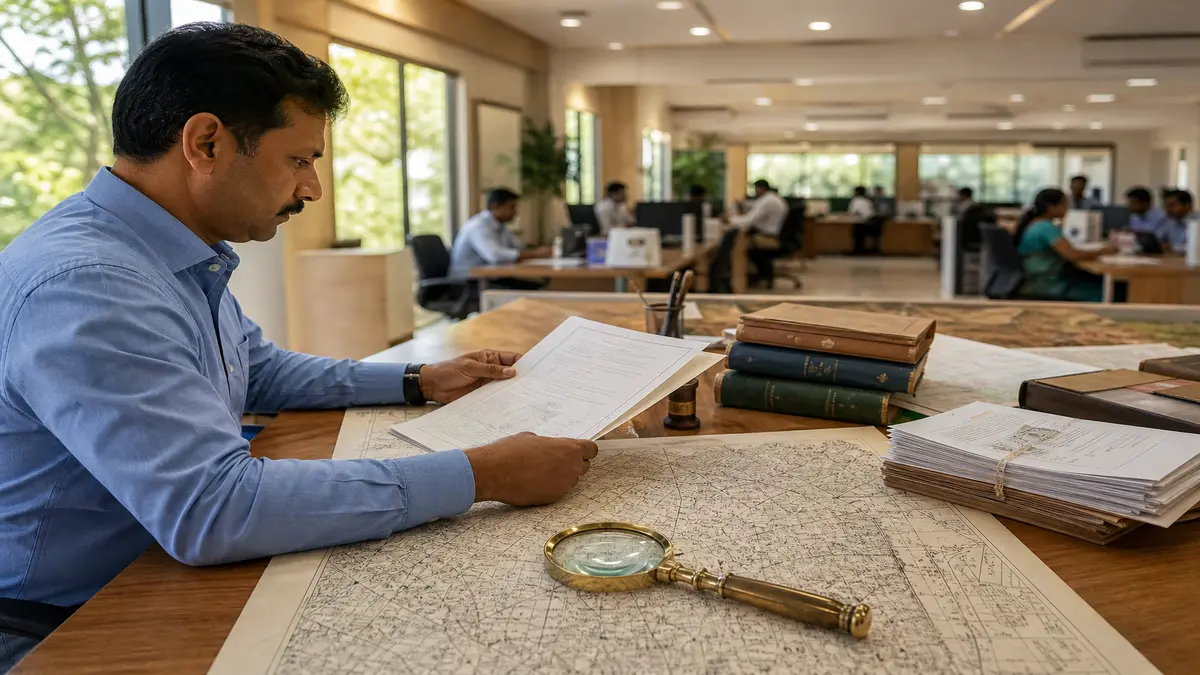
Imagine paying ₹80 Lakh for an open plot in Patancheru, only to receive a legal notice six months later from a private bank. The bank claims the previous owner pledged the land for a business loan. This exact scenario happens every week across Hyderabad and surrounding districts. Buyers trust the seller’s word instead of verifying the registered government records. You can completely avoid this trap by running a simple property background check. Understanding the correct EC Fees in Telangana helps you secure this vital document without facing agent delays or hidden costs.
Property fraud often relies on hidden mortgages or multiple sales of the same survey number. As per recent state revenue observations, over 15% of land disputes in the region trace back to concealed encumbrances. The Encumbrance Certificate acts as the ultimate filter. It exposes every registered sale, lease, gift, or loan tied to the property. If you plan to buy, sell, or take a loan against real estate, you cannot proceed without it. You must know exactly what you are paying for when you apply for this extract.
This comprehensive guide details the precise fee structure for property background searches, the exact steps to apply online via the state portal, and how to read the final document to protect your investment.
| Detail | Info |
|---|---|
| Governing Body | Registration and Stamps Department, Government of Telangana |
| Official Portal | registration.telangana.gov.in |
| Applicable State | Telangana |
| Act Reference | Registration Act, 1908 |
| Application Fee | ₹200 to ₹500 (varies by search period) |
| Processing Time | Instant (Online) to 3 Days (Manual) |
| Helpline / Contact | 1800 599 4788 |
| Last Updated | 2026 |
“An Encumbrance Certificate only shows registered transactions; it will never protect you from an unregistered mortgage or an unrecorded family partition agreement.”
What is an Encumbrance Certificate (EC)?
An Encumbrance Certificate (EC) is a legal document issued by the Sub-Registrar Office that records all registered transactions, mortgages, and legal claims on a specific property over a specified time. It proves whether a property has a free title or carries existing liabilities. Buyers use it to verify absolute ownership before a purchase.
When you apply for this document, the government issues it in one of two formats. If the property has seen sales, mortgages, or lease registrations during the search period, you receive Form 15. This form lists every single transaction date, the document number, and the names of the parties involved. If the property has absolutely zero registered transactions during that time, the office issues Form 16. This is commonly known as a Nil Encumbrance Certificate.
Many buyers confuse this document with a title deed or a Telangana Pahani. The EC does not grant ownership. It merely acts as an index of registered events. If an event is not registered—like an oral agreement or a deposit of title deeds with a private lender—it will not appear here. You must read it alongside the revenue records and actual physical possession.
Objectives and Benefits
The government maintains these transaction registers to create public transparency. The primary objective is to maintain a chronological chain of custody for every surveyed land parcel. This chronological chain prevents the most common real estate frauds, such as selling the same plot to three different buyers on the same day.
- Establishes a verifiable chain of title for a specific survey number.
- Creates a public record of active mortgages and bank attachments.
- Prevents double registration of the same property.
- Standardizes the legal verification process across all Sub-Registrar Offices.
For landowners and property buyers, obtaining this document provides immense practical advantages. It serves as your first line of defense before paying any token advance.
- Protects buyers from investing in properties pledged to banks.
- Allows fast approval of home loans since banks mandate a 13-year clear search.
- Helps legal heirs confirm if their ancestors left any registered debts on inherited land.
- Empowers sellers to prove their clean title and demand accurate market value.
Who Needs This Certificate and When
Different stakeholders require this document at different stages of the property lifecycle. You do not need to pull this record every month. However, at critical financial junctions, skipping this check invites massive legal risk.
| Category | Applicable | When Required |
|---|---|---|
| First-Time Buyers | Yes | Before paying the initial token advance to the seller. |
| Property Sellers | Yes | When listing the property to prove clear title to buyers. |
| Bank Loan Applicants | Yes | When submitting collateral documents for a home loan. |
| Legal Heirs | Yes | Before starting the Bhu Bharati Mutation process for inheritance. |
| NRIs | Yes | To remotely verify that their empty plots are not illegally registered to others. |
Documents Required for EC Application
If you search for the record online, you only need the specific property details. You do not need to upload physical files. However, if the digital portal fails or you need a search prior to 1983, you must visit the Sub-Registrar Office physically. In those manual cases, specific paperwork is mandatory.
| Document | Who Submits |
|---|---|
| Application Form 22 | Buyer or Seller applying manually |
| Copy of Previous Sale Deed | Applicant (for reference of boundaries) |
| Identity Proof (Aadhaar/PAN) | Applicant at the SRO counter |
| Property Address/Survey Number | Applicant (mandatory for online search) |
| Payment Receipt / Challan | Applicant |
Pro Tip
Always keep the exact ward number, block number, and built-up area details handy. A single digit error in the survey number will pull up the history of your neighbor’s property instead of yours, causing unnecessary panic.
Applicable EC Fees and Charges in Telangana
The state government categorizes the fees based on the age of the search. The older the period you wish to check, the higher the cost. This happens because searching very old records requires manual ledger verification by the SRO staff.
For standard property purchases, most legal advisors demand a 13-year or 15-year search. If the property has a complex history, you might need a 30-year search. The calculation relies on a base fee for the first year, plus incremental charges for every additional year.
| Service | Fee (Telangana) | Comparison State (AP) |
|---|---|---|
| Search for the 1st Year | ₹200 | ₹200 |
| Every Additional Year (up to 30 years) | ₹100 per year | ₹100 per year |
| Search beyond 30 Years | Subject to manual SRO assessment | ₹500 flat fee (digital) |
| Online Download (Post-1983) | Free (Informational copy only) | Free (Informational copy) |
| Certified Physical Copy | ₹200 to ₹500 (based on pages) | ₹200 base fee |
If you only need to view the document on your screen to verify a seller’s claim, the online non-certified search costs nothing. You only pay the official EC Fees when you require a mathematically certified copy bearing the digital or physical signature of the Sub-Registrar. Banks and courts only accept the certified copy.
Step-by-Step Process to Obtain Your EC
The government modernized the Registration and Stamps portal to reduce footfall at local offices. You can now pull the initial data directly from your phone or laptop. Follow these specific steps to generate the document securely.
Visit the Official IGRS Portal
Open the Registration and Stamps Department website. Look for the ‘Online Services’ column on the right side of the homepage.
Select Encumbrance Search
Click on the ‘Encumbrance Search (EC)’ link. A disclaimer page will appear explaining that online records start from January 1, 1983.
Accept Terms and Login
Click ‘Submit’ on the disclaimer. Enter your user ID and password. If you are a new user, you must register using your mobile number and email address.
Choose Search Criteria
Select whether you want to search by ‘Document Number’ or by ‘Property Details’. Using the document number is always faster and more accurate.
Enter Property Specifics
Input the year of registration and the specific SRO where the document was executed. If searching by property, select your district, mandal, and village.
Define the Search Period
Input the start year and end year for your search. The system will automatically calculate the required EC fees based on the duration you select.
Make Payment and Download
Use the T-Web gateway to process the payment via UPI, net banking, or debit card. Once successful, the portal generates a PDF copy for immediate download.
Common Errors and Corrections
Digital land records look perfect on screen, but they run on human data entry. Clerks digitizing thousands of old ledgers frequently make typographical mistakes. These small errors create massive headaches during property registration or loan approvals. You must identify and correct these mistakes immediately.
When you download the digital copy, compare every line with your original physical sale deed. A discrepancy in the document number or the spelling of the Pattadar’s name can halt your real estate transaction entirely.
| Common Error | How to Correct It | Authority Involved |
|---|---|---|
| Missing Transaction Entry | Submit manual application with original deed copy | Sub-Registrar Office (SRO) |
| Wrong Survey Number | File a rectification deed signed by both original parties | SRO / Revenue Inspector |
| Name Spelling Mismatch | Submit Aadhaar and affidavit for database correction | SRO / District Registrar |
| Mortgage showing active after clearing loan | Submit Bank NOC and Receipt to clear the charge | SRO |
| Total Area Mismatch | Apply for surveyor physical verification and report | Tahsildar / SRO |
Watch Out
The most dangerous error is a lingering bank mortgage. Even if you paid off your home loan completely, the bank’s claim remains active on the public record until you officially register the Bank NOC (Receipt) at the Sub-Registrar Office. Never assume a loan is cleared just because the bank returned your original papers.
Landowner and Buyer Rights
The Registration Act of 1908 and local state laws grant you specific rights regarding your property records. Many buyers accept bureaucratic delays silently because they do not know their legal standing. You have statutory backing to demand accurate records.
- Right to Information: You have the legal right to inspect the registers or obtain extracts of any registered property upon paying the prescribed EC Fees.
- Right to Digital Delivery: You hold the right to download informational copies online without visiting the SRO, ensuring transparency.
- Right to Rectification: If the department makes a clerical error during digitization, you have the right to get it corrected without paying penalty fees.
- Right to Appeal: If an SRO refuses to issue a clear certificate despite you providing a valid Bank NOC, you can appeal to the District Registrar.
- Right to Clear Title: A buyer has the absolute right to demand a 13-year or 30-year certified extract from the seller before finalizing the sale agreement.
5 Things Every Buyer Must Know Before Paying EC Fees
- Check Document Numbers
Always search by the specific document number rather than just the survey number to avoid getting mixed results from adjacent plots.
- Verify SRO Jurisdiction
Property boundaries change. Ensure you are searching in the correct Sub-Registrar Office, as new offices frequently split from older ones.
- Match with Revenue Records
A clean search result means nothing if the Record of Rights Telangana (1-B) shows a completely different owner.
- Beware the 1983 Cutoff
Online data only goes back to January 1, 1983. For properties registered in the 1970s, you must submit a manual application.
- Bank Mortgages Linger
Private lenders often register a mortgage but forget to remove it. You must ensure the discharge deed is formally registered.
Did You Know?
Before the CARD (Computer-aided Administration of Registration Department) system launched in 1999, clerks manually wrote every property transaction in massive leather-bound ledger books. Searching for an encumbrance meant literally blowing dust off pages and reading handwriting for hours. Today, that same process takes 45 seconds online.
Reality Check: What This Portal Cannot Fix For You
The state digital portals are incredibly fast, but they operate with severe blind spots. The system only outputs exactly what was fed into it. If a fraudulent transaction was successfully registered by bypassing the manual checks ten years ago, the digital certificate will display that fraud as a legitimate entry. The computer does not verify truth; it only verifies registration.
Civil court stays represent a massive danger zone. If two brothers are fighting over an inherited plot in the district court, the judge might issue an injunction (stay order) stopping any sale. If the court clerk or the lawyer fails to manually deliver that stay order to the local Sub-Registrar, the property will still show a Nil Encumbrance. A buyer will pay the money, buy the land, and immediately face contempt of court.
Equitable mortgages provide another trap. Businessmen often take massive private loans by simply handing over their original physical sale deeds to a lender. They sign a promissory note, but they do not register the mortgage at the SRO to save on stamp duty. Your online search will show the property is completely clear. You buy it, only to realize the seller doesn’t have the original papers.
Finally, portal downtime remains a reality. During peak tax collection months or server migrations, the IGRS payment gateway often times out. You might pay the required fees, the money leaves your bank, but the certificate fails to generate. Always verify physical possession and talk to the neighbors. The digital record is only half the story.
Watch Out
The single most important mistake buyers make is trusting the Encumbrance Certificate blindly without demanding to see the original physical sale deed. If the seller claims they “lost” the original papers and only provides a certified copy, walk away. The property is likely mortgaged informally.
Comparison: Online IGRS vs Manual SRO Application
Many senior citizens still prefer visiting the local office, while younger investors rely entirely on the digital portal. Both methods have distinct advantages depending on the age of the property you are investigating.
Digital Search vs Manual SRO Search
| Factor | Online Portal Search | Manual SRO Application |
|---|---|---|
| Time Taken | Instant download | 2 to 5 working days |
| Data Availability | Only post-1983 records | All historical records (pre-1983) |
| Legal Validity | Informational unless digitally signed | Fully certified for court/bank use |
| Payment Method | UPI / Net Banking | Physical Challan / Cash at counter |
| Error Resolution | Cannot fix errors online | Direct interaction with officials |
Expert Tip
Never settle for a 13-year search if you are buying an independent house or agricultural land. Always pay the extra fee and demand a 32-year search. We frequently see cases where a minor’s rights were suppressed in a 1995 partition deed, which a 13-year search will completely miss.
Official Land Records Resources
Scam websites often mimic government portals to steal application fees. Always verify the domain name before entering your property details or making a payment. The government will never ask for payment via direct WhatsApp links.
| Resource | Purpose | URL (plain text) |
|---|---|---|
| IGRS Telangana | Encumbrance & Registration Search | registration.telangana.gov.in |
| Bhu Bharati Portal | Telangana Land Record Verification | bhubharati.telangana.gov.in |
| Revenue Department | Policy & Stamp Duty Updates | revenue.telangana.gov.in |
| Meebhoomi Portal | AP Land Record Verification | meebhoomi.ap.gov.in |
Frequently Asked Questions
What are the exact EC Fees for a 15-year search in Telangana?
For a 15-year search, the fee is generally calculated at ₹200 for the first year and ₹100 for each subsequent year. However, if you pull the informational copy online without a digital signature, the portal allows you to view it for free. Certified copies require payment through the official challan system.
Can I check the Encumbrance Certificate online for free?
Yes. The IGRS Telangana portal allows users to search and view the document for free. This non-certified copy is excellent for initial verification. If you need the document for a bank loan or a court case, you must apply for a digitally signed certified copy and pay the prescribed fees.
Why does my property show ‘Nil Encumbrance’ when I have a bank loan?
If you took a loan by depositing your title deeds but the bank did not formally register a Memorandum of Deposit of Title Deeds (MODT) at the Sub-Registrar Office, the system will not capture it. The portal only reflects transactions that are legally registered and stamped.
Are EC Fees refundable if the system crashes?
If your bank account is debited but the portal fails to generate the document, the system usually initiates an automatic refund within 7 to 10 working days. You can also raise a grievance ticket on the IGRS portal using your transaction reference number to track the failed payment.
What is the difference between Form 15 and Form 16?
Form 15 is issued when the property has active registered transactions, such as sales, leases, or mortgages during your specified search period. Form 16 is issued when there are zero registered transactions found for that property during the requested timeframe.
Can I get an encumbrance record for the year 1975 online?
No. The online digital database in Telangana only contains records starting from January 1, 1983. To obtain records from 1975, you must visit the specific Sub-Registrar Office in person, submit a manual application, and allow the staff to physically search the old ledger books.
Need Help with a Land Records Issue
Whether you are checking a Pahani entry, tracking a mutation application, or verifying a patta — our team can guide you to the right resource.
Chat with us on WhatsApp or email us at [email protected]
Download the BigProperty App to check land record status, track mutation applications, and get property alerts in Hyderabad.

