
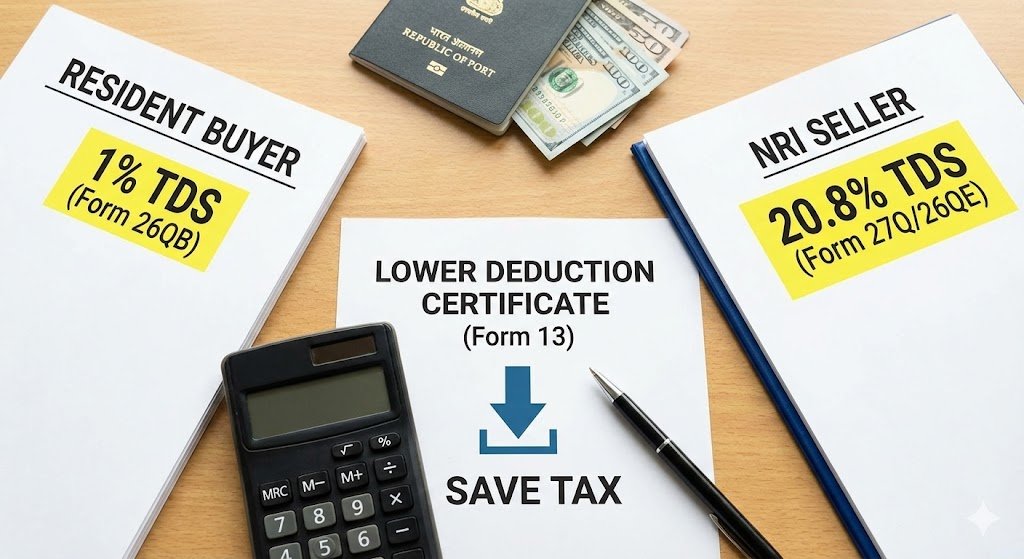
Selling a property in India as an NRI is profitable, but the tax implications can be a rude shock.
Imagine selling your apartment in Hyderabad for ₹1 Crore. You expect to receive the full amount, but the buyer transfers only ₹76 Lakhs to your account.
Where did the remaining ₹24 Lakhs go?
It went straight to the Income Tax Department as TDS (Tax Deducted at Source).
Many NRIs are confused: “My brother sold his house and paid only 1% TDS. Why am I paying 20%?”
This article is part of our Ultimate NRI Real Estate Investment Guide 2026. For a complete overview of FEMA rules and investment strategies, read the full guide here:
In this guide, we clarify the 20% vs. 1% TDS rule, explain the hidden “Surcharge” that increases the rate, and show you legal ways to lower this tax.
The Core Rule: Resident vs. NRI Seller
The TDS rate depends entirely on the Residential Status of the Seller, not the location of the property.
Scenario A: Seller is a Resident Indian
- TDS Rate: 1% of the sale consideration.
- Condition: Applicable only if the property value is above ₹50 Lakhs.
- Process: Buyer files Form 26QB.
Scenario B: Seller is an NRI (Non-Resident Indian)
- TDS Rate: 20% (for Long Term Capital Gains) or 30% (for Short Term).
- Condition: Applicable on ANY value (even if the property is sold for ₹10 Lakhs).
- Process: Buyer must obtain a TAN and file Form 27Q (or use the new Form 26QE for personal purchases).
The Catch: The 20% rate is not flat. You must add Surcharge and Cess, which makes the effective rate much higher.
Related Article:
Tax Deducted at Source: All About TDS Meaning, Filing& Return
BREAKING: No TAN Required for Buying Property from NRI (Budget 2026 Update)
Effective TDS Rates for NRIs in 2026
The “20%” figure is misleading. The actual deduction is calculated as:
Base Rate + Surcharge + Health & Education Cess (4%)
| Sale Value of Property | Effective TDS Rate (Long Term > 2 Years) |
| Up to ₹50 Lakhs | 20.80% (20% + 4% Cess) |
| ₹50 Lakhs to ₹1 Crore | 22.88% (20% + 10% Surcharge + 4% Cess) |
| Above ₹1 Crore | 23.92% (20% + 15% Surcharge + 4% Cess) |
Example:
If you sell a villa in Mokila for ₹2 Crores:
- The buyer will deduct 23.92% = ₹47.84 Lakhs.
- You receive only ₹1.52 Crores.
Related Article:
List Of Legal Documents to Buy Property in India: Property Ownership
How to Lower TDS: The “Lower Deduction Certificate” (LDC)
This is the secret weapon for smart NRIs. You do not have to pay 23.92% TDS if your actual profit (Capital Gain) is low.
The Logic: TDS is calculated on the Sale Value (Total Price). Income Tax is calculated on the Profit (Capital Gain).
Example:
- You bought a plot in 2010 for ₹50 Lakhs.
- You are selling it in 2026 for ₹80 Lakhs.
- Profit: ₹30 Lakhs.
- TDS (23.92% on ₹80L): ₹19.13 Lakhs.
- Actual Tax Liability (20% on ₹30L): ₹6 Lakhs.
- Excess Tax Deducted: ₹13.13 Lakhs! (Why block this money?)
The Solution: Apply for a Lower Deduction Certificate (Form 13) online via the Income Tax Portal before executing the sale deed. If the Assessing Officer is convinced, they will issue a certificate authorizing the buyer to deduct TDS at a lower rate (e.g., 3% or 5% instead of 20%).
Related Article:
BREAKING: No TAN Required for Buying Property from NRI (Budget 2026 Update)
How to Pay ZERO Tax: Capital Gains Exemptions
If you want to save the entire tax amount, you can reinvest your profit under these sections:
1. Section 54 (Buy Another House)
If you sell a residential property and reinvest the Capital Gains (Profit) into buying another residential house in India.
- Time Limit: Purchase within 2 years or construct within 3 years.
- Condition: You cannot buy commercial property or a plot (unless you build a house on it).
2. Section 54EC (Capital Gain Bonds)
If you don’t want to buy another property, invest the profit in REC or NHAI Bonds.
- Lock-in Period: 5 Years.
- Interest Rate: Approx 5% (Taxable).
- Max Limit: ₹50 Lakhs per financial year.
Related Article:
Best Way to Send Money to India for Property Purchase (Low Fees)
Final Verdict: The 3-Step Strategy for NRIs
Don’t let tax fears stop your sale. Follow this simple roadmap in 2026:
- Calculate Liability: Check if your actual tax is lower than 20% of the sale value.
- Apply for LDC: Ask your CA to file Form 13 at least 45 days before the registration date.
- File ITR: If you couldn’t get LDC, let the buyer deduct 20%. File your Income Tax Return (ITR) in July and claim the excess amount as a Refund.
Must Read:
Complete Guide to Plot Loans in Hyderabad: Interest Rates & Banks List (2026)
FAQs: TDS on NRI Property Sale
The Buyer is responsible for deducting TDS and filing the form. However, as the Seller (NRI), you must ensure they deposit it correctly so it reflects in your Form 26AS.
It typically takes 30 to 45 days from the date of application. Plan your sale agreement accordingly to allow this time.
You can repatriate up to $1 Million USD per financial year after paying the applicable taxes. You will need a Chartered Accountant to issue Form 15CA and 15CB to the bank.

 and Section)