
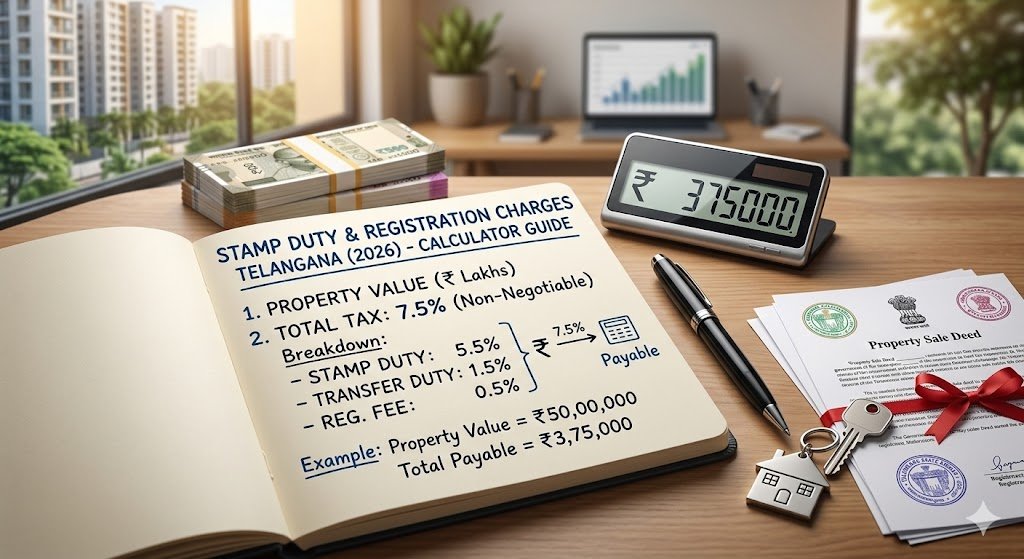
Imagine this: You finally save ₹50 Lakhs to buy your dream plot in Shadnagar. You negotiate with the seller, shake hands, and go to the Registrar Office.
There, the officer asks you for a Demand Draft (DD) of ₹3.75 Lakhs.
You freeze. “What ₹3.75 Lakhs? I already paid the seller!”
The officer replies, “That was for the seller. This is for the Government.”
This is a common nightmare for first-time investors. The “Property Cost” is not the “Final Cost.” You must add the Telangana Government’s Share (Stamp Duty & Registration Charges) to your budget.
This article is part of our Ultimate Property Registration Guide 2026. Before calculating the taxes, ensure you understand the full legal process on the new Bhu Bharati portal.
In this guide, we break down the 2026 Official Rates for Plots, Flats, and Villas, and show you exactly how to calculate the extra cash you need before registration day.
The Golden Rule: The “7.5%” Formula
In 2026, the Telangana Government charges a total of 7.5% on the property value for registration.
This is one of the highest in India, but it is non-negotiable.
Here is the breakdown of that 7.5%:
| Charge Type | Percentage | Who Gets It? |
| Stamp Duty | 5.5% | State Revenue Department |
| Transfer Duty | 1.5% | Local Body (Municipality/Gram Panchayat) |
| Registration Fee | 0.5% | Registration Department |
| Total | 7.5% | The Government |
Note: For flats/apartments, the rate remains the same, but the calculation method (on UDS vs. Built-up Area) differs slightly.
Example Calculation:
If you buy a plot for ₹20,00,000:
- Stamp Duty (5.5%): ₹1,10,000
- Transfer Duty (1.5%): ₹30,000
- Reg Fee (0.5%): ₹10,000
- Total Extra Cost: ₹1,50,000
Related Article: Step-by-Step Process of Property Registration in Telangana (Bhu Bharati Portal)
The “Market Value” Trap (Crucial Concept)
This is where 90% of people get confused.
You pay the 7.5% tax on the Higher Value between two numbers:
- Sale Consideration: The actual price you pay to the seller (e.g., ₹50 Lakhs).
- Market Value (Govt Rate): The government’s fixed rate for that area (e.g., ₹20,000 per sq yard).
Scenario A (The “Black Money” Problem):
- Govt Rate: ₹20 Lakhs.
- Actual Price: ₹50 Lakhs.
- Rule: You must pay tax on ₹50 Lakhs (because it is higher).
- Reality Check: Many people register at ₹20 Lakhs to save tax and pay the remaining ₹30 Lakhs in cash. Warning: This is illegal and risky. If the government catches you (Section 47A of the Stamp Act), you face heavy penalties.
Scenario B (The “Bad Investment” Problem):
- Govt Rate: ₹50 Lakhs.
- Actual Price: ₹40 Lakhs (Distress Sale).
- Rule: You still have to pay tax on ₹50 Lakhs (Govt Rate). The Registrar does not care if you got a discount.
Related Article: Is Shadnagar Safe for NRI Investment? (Growth & Legal Report)
The Myth: “Is it Cheaper for Women?”
In many Indian states like Delhi or Haryana, if you buy property in a woman’s name, you get a 1-2% discount on Stamp Duty.
In Telangana (2026), this is a MYTH.
The Telangana Government charges a uniform rate regardless of gender.
- Male Buyer: 7.5%
- Female Buyer: 7.5%
- Joint Owners: 7.5%
So, don’t register the property in your wife’s name just to save tax. Do it only if you genuinely want her to be the owner for estate planning or loan eligibility reasons.
Related Article: Power of Attorney (GPA) Format for NRIs Buying Property in Hyderabad
The “Hidden” Costs: What the Agent Won’t Tell You
Apart from the big 7.5%, there are small “service charges” that add up. While they seem tiny, you should carry cash/digital payments for them.
- Mutation Fee (0.1%): Usually ₹2,500 – ₹5,000 depending on the plot size. This is paid during registration for the instant name change in revenue records.
- User Charges: Approx ₹500 – ₹1,000 for scanning documents and biometric verification.
- Document Writer Fee: If you hire a professional to draft the Sale Deed, they charge ₹10,000 – ₹25,000.
- Franking Charges: If you use physical non-judicial stamp paper for the agreement, the bank or vendor charges a small commission (0.1%).
Pro Tip: Always keep a buffer of ₹50,000 over and above the 7.5% for these miscellaneous expenses.
Related Article: Step-by-Step Process of Property Registration in Telangana (Bhu Bharati Portal)
The 2026 “Ready Reckoner” Table
Don’t want to do the math? Here is a simple table. Find your property budget and see the minimum cash you need for registration.
| Property Value (Sale Deed Value) | Stamp Duty (5.5%) | Transfer Duty (1.5%) | Reg Fee (0.5%) | Total Tax Payable (7.5%) |
| ₹ 20,00,000 | ₹ 1,10,000 | ₹ 30,000 | ₹ 10,000 | ₹ 1,50,000 |
| ₹ 30,00,000 | ₹ 1,65,000 | ₹ 45,000 | ₹ 15,000 | ₹ 2,25,000 |
| ₹ 50,00,000 | ₹ 2,75,000 | ₹ 75,000 | ₹ 25,000 | ₹ 3,75,000 |
| ₹ 75,00,000 | ₹ 4,12,500 | ₹ 1,12,500 | ₹ 37,500 | ₹ 5,62,500 |
| ₹ 1,00,00,000 | ₹ 5,50,000 | ₹ 1,50,000 | ₹ 50,000 | ₹ 7,50,000 |
Golden Rule for NRIs:
Pay the FULL tax on the actual transaction value.
If you pay ₹50 Lakhs but register at ₹20 Lakhs to save ₹2.25 Lakhs in tax, you are creating ₹30 Lakhs of Black Money.
When you sell this property 5 years later and want to repatriate the money to the USA, you will face a Tax Nightmare because you cannot prove where that extra money came from.
Pay the tax. Sleep in peace.
Related Article: NRI Real Estate Investment in India 2026: FEMA Rules & Best Cities
FAQs: Common Questions on Registration Charges
Yes, technically. The Bhu Bharati portal accepts Net Banking, UPI, and Credit/Debit Cards. However, be aware of the “Merchant Discount Rate” (MDR) which can be 1-2% extra on Credit Cards. It is better to use Net Banking (RTGS/NEFT) for large amounts.
Yes, but it is difficult. If you buy the Challan but the deal falls through, you can claim a refund within 6 months. The government deducts 10% as cancellation charges. The process is slow and requires manual application at the District Registrar’s office.
Yes! If the property value is ₹50 Lakhs or more, the buyer must deduct 1% TDS from the payment to the seller and deposit it with the Income Tax Department (Form 26QB). This is separate from the 7.5% Stamp Duty.
Registration charges are calculated based on the rates active on the Date of Registration, not the date of agreement. If the government hikes the rates tomorrow, you pay the new rate. That’s why smart investors register ASAP.
No. There is No GST on the sale of open plots or land. GST (5% or 12%) is applicable only on under-construction flats or villas.

, Transfer Duty (1.5%), and registration fees (0.5%) for plots and flats.)