
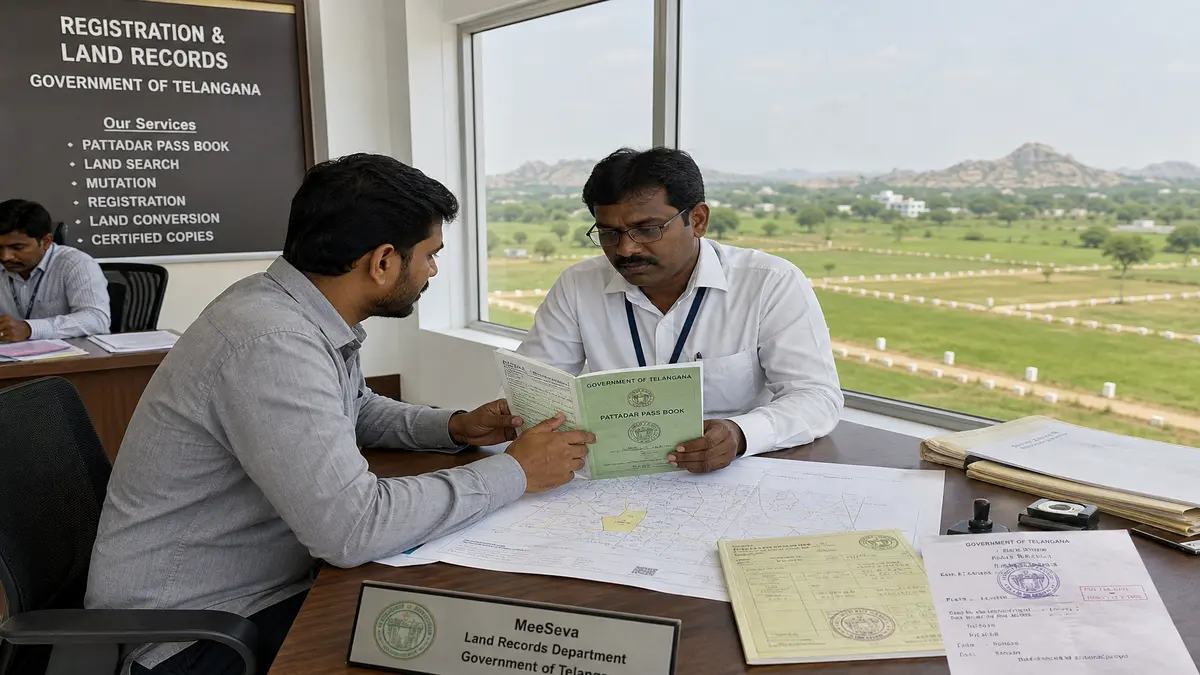
Imagine paying ₹50 lakh for a farm plot near Shadnagar, only to find the seller’s name does not match the government database on the day of the sale. Your registration hits a wall, your money is tied up, and the seller stops taking your calls. This is a daily reality for property buyers who do not verify official records before executing a transaction. In 2026, understanding Land Registration Telangana is non-negotiable for anyone investing in the state.
Property registration is the only legal way to prove you own a piece of real estate. State records show that nearly 15% of land transactions face delays due to mismatched documents, pending tax dues, or prohibited survey numbers. The state government has completely digitized agricultural land transfers through the Bhu Bharati portal, while non-agricultural properties are managed through the IGRS system. Knowing which portal to use, what documents to carry, and how much stamp duty to pay can save you weeks of running around revenue offices.
This comprehensive guide explains the complete property registration process, from preparing your documents and calculating government fees to booking your slot and securing your final mutation certificate.
| Detail | Info |
|---|---|
| Governing Body | Registration and Stamps Department, Telangana |
| Official Portal (Agricultural) | bhubharati.telangana.gov.in |
| Official Portal (Non-Agricultural) | registration.telangana.gov.in |
| Applicable State | Telangana |
| Act Reference | Registration Act, 1908 & TS Rights in Land Act, 2020 |
| Application Fee | Varies by property value (typically ₹1000 – ₹5000 booking fee) |
| Processing Time | Same day for Bhu Bharati, 1-3 days for IGRS |
| Helpline / Contact | 1800 599 4788 |
| Last Updated | 2026 |
“A registered sale deed proves you paid for the land, but only a successful mutation proves you actually own it in the government’s eyes.”
What is Land Registration Telangana?
Land Registration Telangana is the official process of recording a property transfer in the government’s registry. Under Section 17 of the Registration Act, 1908, any transaction involving immovable property worth more than ₹100 must be registered. This creates a permanent, legally binding public record of ownership.
The state operates a dual system for property registration. If you are buying agricultural land, the entire process—from slot booking to instant mutation—happens on the Bhu Bharati portal (the upgraded version of the Dharani system). The local Tahsildar acts as the Joint Sub-Registrar for these transactions. The process is streamlined, meaning the buyer walks out with a registered deed and an updated Pattadar Passbook on the same day.
For non-agricultural properties like open plots, flats, and commercial buildings, the transaction goes through the IGRS (Integrated Grievance and Registration System) portal. You book a slot through the Public Data Entry (PDE) system and visit the regular Sub-Registrar Office (SRO). This process requires a separate application for mutation after the registration is complete. Understanding this distinction is the first critical step for any property buyer.
Primary Objectives and Landowner Benefits
The government enforces property registration to maintain clear ownership records and prevent fraudulent sales. From a legal standpoint, an unregistered sale deed has no value in a civil court.
- To create a public, searchable record of property ownership.
- To guarantee the legal title of the buyer against future claims.
- To collect stamp duty and registration fees for state revenue.
- To prevent the double sale of the same property to multiple buyers.
For property buyers and landowners, registering a property unlocks several essential benefits.
- Provides absolute legal protection against encroachments and title disputes.
- Makes the property eligible for bank loans and mortgages.
- Allows the owner to apply for building permissions and municipal approvals.
- Ensures a smooth transfer of property to legal heirs during inheritance.
Who Needs to Register Property?
Property registration applies to almost every real estate transaction. Whether you are buying a new flat from a builder or inheriting ancestral farmland, the transfer must be recorded.
| Category | Applicable | When Required |
|---|---|---|
| Property Buyers | Yes | Immediately upon executing a sale agreement or sale deed. |
| Legal Heirs | Yes | When transferring title after the death of the original owner. |
| Gift Recipients | Yes | When receiving property as a gift from family members. |
| NRIs | Yes | When buying or selling property through a General Power of Attorney. |
| Banks and Lenders | Yes | When registering a mortgage deed against a property loan. |
Documents Required for Land Registration
Missing a single document can result in your registration slot being cancelled. The Sub-Registrar requires absolute proof of the seller’s title and the buyer’s identity before approving the transfer.
| Document | Who Submits |
|---|---|
| Original Title Deed (Link Document) | Seller |
| Latest Encumbrance Certificate (EC) | Seller |
| Pattadar Passbook (for agricultural land) | Seller |
| Aadhaar Cards and PAN Cards | Both Parties |
| Recent Property Tax Receipt | Seller |
| Challan for Stamp Duty Payment | Buyer |
| Section 32A Form (Photographs & Thumbprints) | Both Parties |
Pro Tip
Ensure that the seller’s name on their Aadhaar card exactly matches the name printed on the Pattadar Passbook or the previous sale deed. Even a missing surname initial will cause the biometric authentication to fail during the registration process.
Applicable Fees and Stamp Duty Charges
Property registration costs are the largest additional expense when buying real estate. The Telangana government calculates these charges based on the property’s market value or the official guidance value (Basic Value Register), whichever is higher.
| Fee Type | Telangana Rate (2026) | Comparison (Andhra Pradesh) |
|---|---|---|
| Stamp Duty (Urban Areas) | 5.5% of property value | 5.0% of property value |
| Stamp Duty (Rural Areas) | 4.0% of property value | 4.0% of property value |
| Registration Fee | 0.5% of property value | 1.0% of property value |
| Transfer Duty | 1.5% of property value | 1.5% of property value |
| Mutation Fee | ₹250 – ₹1000 per application | ₹500 per application |
Calculating Property Valuation and Registration Costs
Before you pay any fees, you must determine the official value of your property. The Registration Department maintains a Basic Value Register for every village and municipality. You cannot register a property for an amount lower than this government-fixed rate.
For example, if you buy a plot for ₹40 lakh, but the government’s basic value for that area dictates the plot is worth ₹50 lakh, you must pay stamp duty on ₹50 lakh. If the basic value is ₹30 lakh, but your sale agreement states ₹40 lakh, you pay stamp duty on the higher amount of ₹40 lakh. This prevents buyers from under-reporting transaction values to evade taxes.
To calculate your total cost, add the stamp duty, registration fee, and transfer duty. In a Telangana municipality, this typically totals 7.5% of the property’s value. You must generate a single challan for this exact amount through the online portal before booking your registration slot.
How to Access Registration Services Online
The state has minimized physical interactions at revenue offices by moving the pre-registration process online. Here is the exact process to register an agricultural property using the state portal.
Log into the Portal
Visit the official Bhu Bharati website. Create a citizen login using your mobile number and generate an OTP to access the dashboard.
Select the Service
Click on the ‘Application for Registration of Sale/Gift’ option. Enter the seller’s Pattadar Passbook number and the specific survey number being transferred.
Enter Transaction Details
Input the buyer’s details, including their Aadhaar number and family member details. Enter the total agreed sale consideration amount.
Calculate and Pay Fees
The system will automatically calculate the stamp duty and registration fees based on the survey number’s location. Pay this amount using net banking, UPI, or a debit card.
Book the Registration Slot
Once payment is successful, a calendar will appear. Select a convenient date and time to visit the Tahsildar office (acting as the Joint Sub-Registrar).
Visit the Office for Biometrics
Both the buyer and seller must visit the office at the allotted time with two witnesses. The officer will capture thumbprints via a biometric device.
Collect the Documents
After successful verification, the officer will print the registered deed, digitally sign the mutation order, and hand over the updated documents.
Common Errors and Corrections
Even a minor clerical error can freeze your property transfer. Understanding what usually goes wrong helps you prepare a flawless application.
| Common Error | How to Correct It | Authority Involved |
|---|---|---|
| Survey Number Listed as Prohibited | File an exclusion grievance with supporting old link documents. | District Collector |
| Aadhaar Biometric Failure | Update biometrics at an Aadhaar center before the slot date. | UIDAI / SRO |
| Extent of Land Mismatch | Request a physical survey to rectify the subdivision sketch (Tippan). | Mandal Surveyor |
| Seller Name Typo in Portal | Apply for a Data Correction grievance through the digital portal. | Tahsildar |
Watch Out
Never ignore the NALA (Non-Agricultural Land Assessment) conversion status. If you buy agricultural land that was plotted without a formal NALA conversion order, the government still treats it as farmland. You will not get building permission.
Landowner and Buyer Rights
Citizens have specific statutory rights during the registration process to ensure fairness and transparency.
- Right to Valuation Appeal: If you believe the basic value is unfairly high, you can appeal to the District Registrar for a manual revision under the Registration Rules.
- Right to Instant Mutation: For agricultural lands, the buyer has a right to immediate mutation and an e-Pattadar Passbook without paying separate bribes or extra fees.
- Right to Refuse Unofficial Fees: The exact fee is printed on your online challan. Buyers have the right to refuse any demand for manual cash payments at the SRO.
- Right to Document Return: The Sub-Registrar must return the original registered document within the stipulated time, usually the same day for digital registrations.
5 Things Every Property Buyer Must Verify Before Registration
- Check the 1-B Extract
Verify that the seller is the absolute owner in the government’s Record of Rights.
- Verify Prohibited Lists
Ensure the survey number is not listed under Section 22-A (government or assigned lands).
- Clear Tax Dues
Demand the latest property tax receipt; unpaid municipal taxes transfer to the new buyer.
- Check Civil Disputes
Pull a 20-year EC to ensure no family member has registered a civil court stay on the land.
- Prepare Valid Witnesses
Bring two trustworthy witnesses with valid Aadhaar cards; strangers outside the SRO can cause legal trouble later.
Did You Know?
A registered General Power of Attorney (GPA) does not actually transfer property ownership. It only authorizes someone to execute a sale on your behalf. To legally become the owner, a formal Sale Deed must still be executed and registered.
Reality Check: What This Portal Cannot Fix For You
While the state’s digital platforms have eliminated middlemen for straightforward transactions, they are not a cure-all. Legacy data issues still plague the system. When millions of manual ledger entries were migrated to the digital portal, thousands of names were misspelled, and land extents were incorrectly typed. If the seller’s land is caught in this data migration mess, the portal will not allow slot booking until a manual correction is approved by the Collector.
Civil court stays are another massive hurdle. The digital system relies on revenue officers updating court orders. If an aggrieved family member gets an injunction from a civil court but the Tahsildar has not updated the digital database, the portal might still show the land as clear. A buyer could complete the registration only to face a nasty legal battle later.
Portal downtime is a harsh reality. Server crashes on the last working day of the month are common, leading to missed slots and expired challans. If a slot is missed due to a server error, buyers often have to navigate a complex refund process or request a manual reschedule, which can take weeks.
Finally, the digital portal does not verify physical boundaries. The system will happily register one acre of land based on the survey number, even if someone has illegally fenced off half of it on the ground. A digital document does not protect you from physical encroachment.
Watch Out
The single most dangerous mistake buyers make is trusting the digital portal’s land extent without hiring a private surveyor to physically measure the boundaries before registration.
Post-Registration: Mutation and Record Updates
Registration is only half the battle. Mutation is the process of updating the government’s revenue records to reflect you as the new taxpayer and owner. Without mutation, the previous owner still receives the property tax bills, and technically, the government still views them as the titleholder for compensation purposes.
For agricultural land, the state has simplified this. The moment the Joint Sub-Registrar approves the registration on the digital portal, the mutation happens automatically. The buyer receives a digitally signed e-Pattadar Passbook on their smartphone, and the physical passbook is dispatched via post.
For non-agricultural properties (flats and urban plots), mutation requires a separate step. After collecting your registered sale deed from the SRO, you must apply for mutation through the Dharani/Bhu Bharati urban module or the local municipal corporation portal (like GHMC or TS-bPASS). You will need to upload the registered deed, pay a mutation fee, and wait for the revenue inspector to verify the documents. Only after this process is complete will the property tax be generated in your name.
Agricultural vs Non-Agricultural Registration
| Factor | Agricultural Land | Non-Agricultural Property |
|---|---|---|
| Portal Used | Bhu Bharati (Dharani) | IGRS / CARD |
| Registering Officer | Tahsildar (Joint Sub-Registrar) | Sub-Registrar (SRO) |
| Mutation Process | Automatic & Instant | Requires separate application |
| Key Document Issued | Pattadar Passbook | Registered Title Deed |
| Valuation Basis | Acre / Gunta rate | Square Yard / Square Foot rate |
Expert Tip
Always pull a 20-year Encumbrance Certificate (EC) instead of the standard 13-year default option before booking a registration slot. Many ancestral property disputes stem from unregistered partitions that occurred 15 to 18 years ago, which a short EC will completely miss.
Official Land Records Resources
Always use official government websites to verify records and pay fees. Fraudulent websites often mimic state portals to steal registration fees.
| Resource | Purpose | URL (plain text) |
|---|---|---|
| Bhu Bharati Portal | Telangana Agricultural Land Records | bhubharati.telangana.gov.in |
| IGRS Telangana | Non-Agricultural Property Registration | registration.telangana.gov.in |
| CDMA Portal | Municipal Mutation and Property Tax | cdma.telangana.gov.in |
| Meebhoomi Portal | AP Land Record Verification (For comparison) | meebhoomi.ap.gov.in |
| Bhoomi Portal | Karnataka Land Record Search (For comparison) | landrecords.karnataka.gov.in |
Frequently Asked Questions
What are the timing rules for Land Registration Telangana?
You must present the property documents to the Sub-Registrar within four months from the date of execution (signing). If you miss this deadline, you can still register within the next four months, but the District Registrar will levy a hefty penalty, up to ten times the original registration fee.
How do I check the basic value before Land Registration Telangana?
You can check the basic valuation by visiting the official IGRS Telangana portal. Click on the ‘Market Value Search’ option, select your district, mandal, and village. The system will display the government-mandated price per square yard or acre for both agricultural and non-agricultural lands.
Can I register a property if the seller lost the original link document?
Yes, but it requires extra legal steps. The seller must file an FIR for the lost document and publish a notice in two local newspapers. You must then obtain a certified copy (CC) of the lost deed from the SRO and present the FIR, paper clippings, and an indemnity bond during registration.
What is Section 22-A in property registration?
Section 22-A of the Registration Act lists properties that are strictly prohibited from being sold or registered. This includes assigned lands given to the landless poor, Waqf board properties, endowment lands, and government-owned plots. Registrations on these survey numbers are automatically blocked by the software.
Is a physical Pattadar Passbook mandatory for agricultural registration?
Yes, the seller must possess the digital e-Pattadar Passbook or the physical green book. The portal requires the unique passbook number to fetch the land details. If the seller has misplaced it, they must apply for a duplicate passbook through the portal before attempting to sell the land.
What happens if I under-report the property value to save stamp duty?
If the Sub-Registrar suspects that the actual sale price is much higher than the reported basic value, they can hold your document under Section 41. A spot inspection will be conducted, and you will be forced to pay the deficit stamp duty along with a penalty before the document is released.
Need Help with a Land Records Issue
Whether you are checking a Pahani entry, tracking a mutation application, or verifying a patta — our team can guide you to the right resource.
Chat with us on WhatsApp or email us at [email protected]
Download the BigProperty App to check land record status, track mutation applications, and get property alerts in Hyderabad.

