
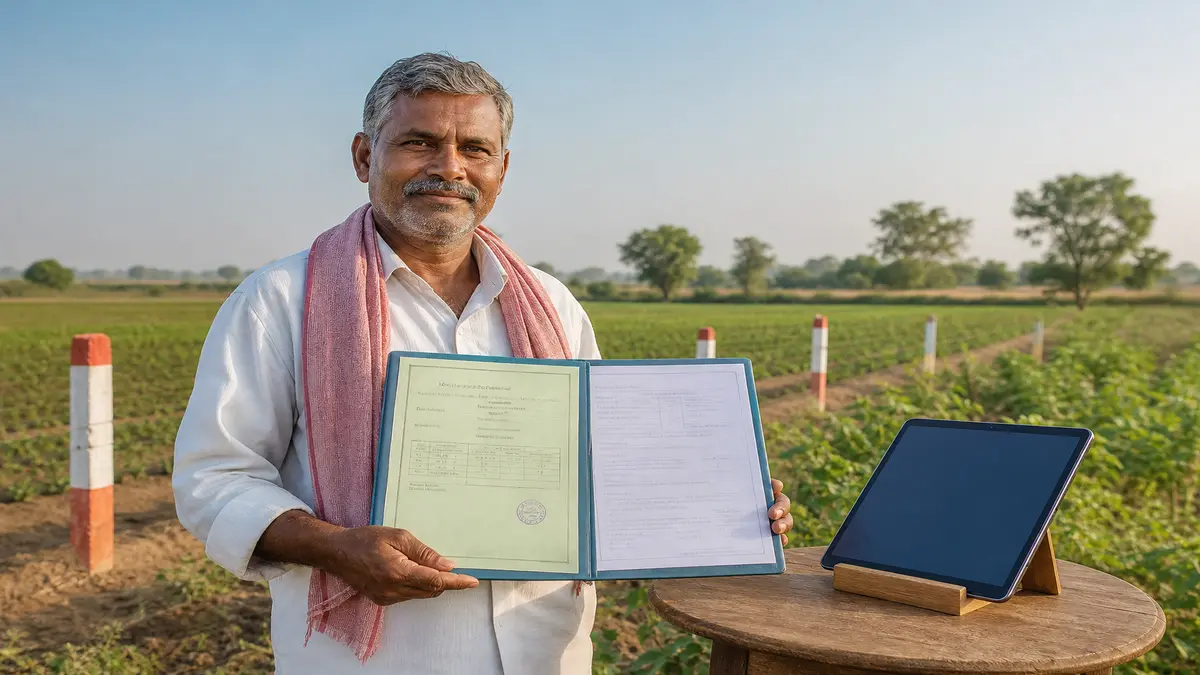
Imagine purchasing three acres of fertile farmland in Ranga Reddy district, only to discover the physical green book handed to you still legally reflects the deceased grandfather of the seller in the government ledger. This exact mismatch paralyzes agricultural subsidies, crop loans, and future resale prospects for thousands of buyers every single year. Securing accurate digital revenue records is non-negotiable for establishing undisputed ownership, and initiating a successful Passbook Apply request through the official state portal is your immediate next step. You cannot afford to leave your property titles lingering in outdated manual registers or unverified village records.
As of 2026, the Bhu Bharati (formerly Dharani), Government of Telangana system mandates that physical possession must perfectly mirror the electronic 1-B register to hold any legal weight. Recent official revenue department data indicates that nearly fifteen percent of legacy land records still contain minor spelling or extent mismatches requiring formal digital correction. The modernization of these revenue portals means manual intervention by local officers is minimized, but the burden of submitting flawless electronic applications falls entirely on the landowner.
This comprehensive guide explains the exact procedures, current fee structures, and strict documentation required to successfully register, mutate, and secure your electronic Pattadar Passbook without falling into common bureaucratic traps.
| Detail | Info |
|---|---|
| Governing Body | Chief Commissioner of Land Administration (CCLA) |
| Official Portal | bhubharati.telangana.gov.in |
| Applicable State | Telangana |
| Act Reference | Telangana Rights in Land and Pattadar Passbooks Act, 2020 |
| Application Fee | ₹1000 to ₹2500 (Varies by transaction type) |
| Processing Time | 7 to 15 Working Days |
| Helpline / Contact | 1800-599-4788 |
| Last Updated | 2026 |
“A physical land deed merely proves you bought the property, but a digital Pattadar Passbook proves the government officially recognizes your exclusive right to own, farm, and sell it.”
What is the Pattadar Passbook in Telangana?
A Pattadar Passbook is an official statutory document issued by the Telangana Revenue Department that serves as absolute proof of agricultural land ownership. It consolidates the title deed, 1-B extract, and survey number boundaries into a single digitally authenticated card tied directly to the landowner’s Aadhaar number. This document is mandatory for selling agricultural land, securing bank mortgages, or claiming state subsidies.
Under the modernized Record of Rights Telangana framework in 2026, the old manual blue and green books have been entirely phased out. The current iteration is a highly secure, tamper-proof electronic record that links directly to the central state servers. This electronic linkage guarantees that any bank loan, government subsidy scheme, or civil court attachment is instantly reflected against the specific survey number. Such strict digital monitoring prevents duplicate sales and blocks unauthorized mortgages from being registered by fraudulent actors.
The process to acquire this vital document has transitioned completely to the digital realm. Property buyers no longer need to chase village revenue officers or carry thick manual files to the Mandal office. Instead, every property transaction, from standard sale deed registration to complex family partition deeds, triggers an automated mutation workflow. Once the local Tahsildar electronically approves the digital file through biometric authentication, the new ownership credential is generated, printed, and dispatched directly via registered post.
Understanding the architecture of these records is critical for long-term security. The passbook draws its data directly from the village Sethwar (original settlement register) and the Pahani (annual tenancy and crop register). If there is a discrepancy between the physical boundaries on the ground and the digital entry in the portal, the digital entry will legally supersede physical claims during any legal dispute. Therefore, maintaining absolute accuracy in your electronic passbook is the ultimate safeguard for your real estate investments.
Core Objectives and Benefits of Digital Land Records
The transition from manual ledgers to a fully centralized portal system was driven by the need to eliminate corruption, speed up property transfers, and provide absolute clarity on title ownership. The revenue department designed the current passbook ecosystem to serve multiple distinct objectives that protect both the state and the citizen.
- Elimination of Duplicate Registrations: The system automatically blocks the registration of any survey number that has already been sold, attached by a court, or marked as prohibited government land.
- Instant Mutation Workflows: Previously, mutation took months of manual follow-ups. Now, the application for title transfer is initiated simultaneously with the sale deed registration.
- Direct Benefit Transfers: Subsidies like Rythu Bandhu and crop insurance payouts are routed directly to the bank account linked to the Aadhaar authenticated passbook.
- Transparent Encumbrance Tracking: Any active bank loan or mortgage is digitally marked on the passbook data, alerting future buyers immediately.
- Fraud Prevention through Biometrics: Revenue officers must use their thumbprints to approve changes, creating a permanent, auditable digital trail of who authorized every title transfer.
For the average property buyer or generational farmer, the benefits of holding a fully updated digital passbook extend far beyond simple compliance. It fundamentally changes how you interact with financial institutions and local authorities.
- Frictionless Bank Loans: Agricultural loans and crop financing are approved significantly faster when the digital 1-B register matches the applicant’s credentials perfectly.
- Quick Dispute Resolution: Boundary arguments with neighbors are resolved swiftly by referencing the digitally signed village map coordinates linked to the passbook.
- Stress-Free Inheritance: Legal heirs face drastically reduced paperwork when transferring ancestral property if the deceased parent held a fully verified digital record.
- Clear Conversion Paths: Before constructing a farm house based on Vastu for South Facing House principles, landowners must ensure their agricultural land is officially converted. A flawless passbook is the mandatory first step for NALA conversion.
- Guaranteed Government Compensation: In the event of land acquisition for highways or irrigation projects, compensation is disbursed exclusively to the registered digital passbook holder without delay.
Who Needs to Apply for a Passbook?
Not every real estate transaction requires a Pattadar Passbook. This document is strictly associated with agricultural land classifications. Urban apartments, commercial plots, and HMDA-approved layouts fall under different municipal registration systems. Understanding whether your specific transaction triggers a passbook requirement saves considerable time and application fees.
| Category | Applicable | When Required |
|---|---|---|
| New Agricultural Buyers | Yes | Immediately during the sale deed registration process. |
| Legal Heirs / Successors | Yes | Following the death of the original landowner via succession mutation. |
| Urban Apartment Buyers | No | Governed by RERA and municipal authorities, not agricultural revenue laws. |
| NRI Landowners | Yes | When purchasing agricultural land (subject to FEMA rules) or inheriting family farms. |
| Gift Deed Recipients | Yes | When agricultural land is transferred between family members without monetary exchange. |
| Plot Buyers in Approved Layouts | No | Non-agricultural land requires municipal mutation, not a Pattadar Passbook. |
Documents Required for Pattadar Passbook Application
The revenue department operates on a strictly evidence-based workflow. A single missing document or a mismatched spelling between your identity proof and your sale deed will result in an immediate automated rejection of your application. Gathering the exact required paperwork before logging into the portal is the most critical phase of the entire process.
| Document | Who Submits |
|---|---|
| Registered Sale / Gift / Partition Deed | The new property owner or legal heir. |
| Recent Encumbrance Certificate (EC) | The applicant, to prove no active prior mortgages exist. |
| Original Old Pattadar Passbook | The seller or previous owner (must be surrendered or updated). |
| Aadhaar Card (Linked to Mobile) | The buyer, for mandatory biometric e-KYC validation. |
| Recent Passport Sized Photographs | The applicant, for physical passbook printing. |
| Death Certificate & Family Member Certificate | Legal heirs applying for succession transfer only. |
| Bank Passbook Front Page | The applicant, for linking government subsidy direct transfers. |
Pro Tip
Ensure your name on the Aadhaar card matches the name on the registered sale deed letter for letter. If your deed says “Venkata Rao” and your Aadhaar says “V. Rao”, the digital system will flag a demographic mismatch and block the passbook generation until an affidavit is submitted.
Passbook Application and Mutation Fee Structure
Financial transparency is a major feature of the 2026 revenue portal upgrades. Applicants no longer deal with vague manual challans. All fees are calculated dynamically by the portal based on the land extent and the type of transaction. Payments are routed through secure state payment gateways, and official receipts are generated instantly.
| Service | Fee (Telangana) | Comparison State (AP) |
|---|---|---|
| Standard Sale Mutation & Passbook | ₹2500 per transaction | ₹1000 to ₹2000 based on area |
| Succession / Inheritance Transfer | ₹1000 processing fee | ₹1000 fixed fee |
| Passbook Data Correction Request | ₹1000 per application | ₹500 per module correction |
| Duplicate Passbook Issuance | ₹1500 (Includes penalty) | ₹1000 + publication charges |
| Aadhaar / Mobile Number Linking | Free of charge | Free of charge |
How to Process Your Passbook Apply Request Online
Citizen Registration and Login
Navigate to the official portal and create a citizen profile using your active mobile number. Complete the OTP verification to access the main services dashboard where all property modules are housed.
Select the Appropriate Module
Click on the ‘Mutation Services’ or ‘Application for Passbook Data Correction’ tab depending on your requirement. Select your specific district, mandal, and village from the cascading dropdown menus.
Enter Property Details
Input your exact survey number or existing passbook number. The system will auto-fetch the current 1-B register details. Verify that the total land extent matches your physical sale deed measurements.
Upload Mandatory Documents
Scan and upload the registered deed, encumbrance certificate, and your Aadhaar copy in strict PDF format. Ensure the file sizes remain under the portal’s specified limits to avoid upload failures.
Process Fee Payment
Review the dynamically generated challan amount. Proceed to the secure payment gateway and complete the transaction using net banking or UPI. Save the digital payment receipt and application number immediately.
Book Tahsildar Slot
Select an available date and time slot from the portal calendar for your physical verification at the local Mandal Revenue Office (MRO). Both buyer and seller must generally be present unless specific exemptions apply.
Biometric Verification and Dispatch
Attend the MRO office at the designated time. The Tahsildar will verify original documents and capture your biometric thumbprint. Upon electronic approval, the passbook is sent for centralized printing and dispatched via post.
Common Passbook Errors and Correction Procedures
Even with advanced digital systems, data migration errors from decades-old manual ledgers frequently surface. When agricultural land is subdivided over generations, the resulting fractional survey numbers often create portal conflicts. Identifying these errors early and knowing the exact correction module to use is vital for maintaining a clean property title.
| Common Error | How to Correct It | Authority Involved |
|---|---|---|
| Incorrect Land Extent (Acres/Guntas) | Apply via ‘Passbook Data Correction’ with original Sethwar copy. | Tahsildar / District Collector |
| Name Spelling Mismatch | Submit Aadhaar demographic update module with affidavit. | Mandal Revenue Officer |
| Missing Sub-Survey Number | File a ‘Missing Survey Number’ grievance with digital field map. | Revenue Divisional Officer |
| Prohibited Land Flag | Submit NALA conversion order or court clearance decree. | District Collector |
| Nature of Land Listed Wrongly | Request classification change supported by current Pahani extract. | Tahsildar |
Watch Out
Never ignore a missing sub-division letter (like Sy. No. 123 instead of 123/AA) in your digital passbook. A missing sub-division means you legally share undivided ownership with the entire primary survey number block, making it impossible to secure individual bank loans or sell your specific parcel later.
Statutory Rights of Landowners Under the 2020 Act
The Telangana Rights in Land and Pattadar Passbooks Act of 2020 radically redefined landowner privileges, shifting power away from village-level bureaucracy and placing it directly into the hands of the citizen through digital transparency. Familiarizing yourself with these statutory rights ensures you can effectively combat any administrative delays.
- Right to Time-Bound Service: Under the latest citizen charter, mutation and passbook generation must be completed within the stipulated 15-day window once biometrics are captured.
- Right to Digital Authenticity: Section 6 of the Act mandates that an electronically downloaded and printed copy of the passbook carries the exact same legal weight as the physical card for all official purposes.
- Right to Appeal: If a Tahsildar rejects a passbook application, the landowner possesses the legal right to file an appeal before the Revenue Divisional Officer (RDO) or the Special Tribunal within specific timeframes.
- Right to Free Access: Citizens hold the right to view, download, and print their Telangana Pahani and 1-B extracts from the state portal without paying manual search fees to local officers.
- Right to Secure Mortgages: Landowners have the explicit right to have their bank loans digitally marked and safely un-marked on the portal upon loan closure, preventing permanent illegal encumbrances.
- Right to Protection from Arbitrary Changes: Revenue officers cannot alter land classifications or ownership details in the portal without triggering an automated SMS alert and issuing a formal digital notice to the registered owner.
5 Things Every Landowner Must Know Before Applying
- Aadhaar linkage is mandatory
Without an active mobile number linked to your Aadhaar, you cannot bypass the OTP gateway to initiate any application.
- Physical surveys matter
Always verify the physical boundary stones match the digital village map coordinates before applying for mutation.
- Court stays freeze everything
If a civil court has issued an injunction on the survey number, the portal will automatically lock the passbook generation process.
- Legacy data rules supreme
Your current application must legally align with the historical Faisal Patti and Sethwar records spanning back decades.
- Bank liens require formal closure
Paying off an agricultural loan does not automatically clear the digital passbook; the bank must electronically release the charge.
Did You Know?
The centralized revenue portal system utilizes an ‘Auto-Lock’ feature. If a specific land parcel is identified under the Prohibited Properties list (Section 22-A), the digital infrastructure entirely blocks the generation of a challan or slot booking, effectively stopping fraudulent registrations before they even begin.
Reality Check: What This Portal Cannot Fix For You
While the state heavily promotes the efficiency of the digital revenue infrastructure, practical field experience reveals severe limitations. The portal acts strictly as a mirror reflecting existing data. If the foundational manual records migrated into the system during 2020 were flawed, the digital passbook will simply digitize and amplify those historical errors. Fixing deep-rooted legacy data requires arduous administrative hearings, not just a simple online application.
Civil court injunctions present another massive roadblock. The digital system operates on binary logic—a property is either clear or disputed. If a distant relative files a partition suit and secures a temporary stay, the portal freezes the survey number instantly. Even if you hold a valid, registered sale deed and physical possession, the Tahsildar cannot physically or digitally issue your passbook until a formal court decree clearing the title is uploaded to the central servers.
Technical downtime and cross-departmental communication failures also plague the process. When agricultural land is converted to non-agricultural use (NALA), the revenue portal is supposed to automatically remove the survey number from the passbook system and transfer jurisdiction to municipal authorities. In reality, this synchronization often lags. Landowners frequently find their plots stuck in digital limbo, unable to secure building permissions because the land still incorrectly reflects as agricultural in the state’s main servers.
Finally, the portal cannot resolve physical boundary disputes. The digital record might state you own precisely 2.5 acres, but if your neighbor’s fence physically encroaches onto your land, the online passbook offers no immediate physical remedy. You still must apply for a formal manual re-survey, pay the challan, and wait for the village surveyor to physically measure the coordinates on the ground before any digital correction can be validated.
Watch Out
The most devastating mistake buyers make is assuming a clean digital portal record guarantees a flawless physical title. Always conduct a physical ground survey and verify the historical 30-year manual link documents. Digital portals only show current status, hiding decades of potentially unresolved family claims.
Passbook Ecosystem: Telangana vs. Andhra Pradesh
Digital Portal Comparison (2026)
| Factor | Bhu Bharati (Telangana) | Meebhoomi (Andhra Pradesh) |
|---|---|---|
| Core Philosophy | Joint Registration & Mutation | Independent Revenue Workflows |
| Passbook Color Code | Digital Green E-Passbook | Electronic Title Deed (E-Title) |
| Mutation Speed | Instant at Sub-Registrar level | Requires separate MRO approval phase |
| Prohibited Land Check | Fully automated pre-registration | Manual verification required in some zones |
| Grievance Resolution | Centralized digital modules | Heavy reliance on village secretariats |
| Biometric Security | Mandatory for all transactions | Aadhaar OTP dominant in select services |
| App Integration | Dedicated citizen mobile modules | Integrated village volunteer network |
| Fee Structure | Higher, consolidated charges | Lower, staggered service fees |
Expert Tip
Before submitting any online application for name correction or extent modification, independently download and securely save copies of your village’s digital Pahani and 1-B registers for the last three consecutive years. If the central server experiences a data rollback during your correction process, these saved PDFs serve as your only proof of previous accurate entries.
Official Land Records Resources
Navigating the correct governmental domain is critical to avoid phishing scams and unauthorized agents. Always ensure the URL in your browser precisely matches the official state directories listed below before entering any sensitive Aadhaar or property data.
| Resource | Purpose | URL (plain text) |
|---|---|---|
| Bhu Bharati Portal | Telangana Land Record Search & Passbook | bhubharati.telangana.gov.in |
| Meebhoomi Portal | AP Land Record Verification | meebhoomi.ap.gov.in |
| Bhoomi Portal | Karnataka Land Record Search | landrecords.karnataka.gov.in |
| Telangana Revenue Dept | Policy Updates & Official Circulars | revenue.telangana.gov.in |
| IGRS Telangana | Encumbrance & Registration Details | registration.telangana.gov.in |
Frequently Asked Questions
How can I track my passbook application status online?
You can track your application by logging into the Bhu Bharati portal and selecting the ‘Application Status’ module. Enter your unique transaction ID or the application number generated during fee payment. The system will display the exact current stage, indicating whether it is pending Tahsildar approval, biometric capture, or dispatched for printing.
What should I do if my physical passbook is lost?
If you lose your physical document, you must immediately file a First Information Report (FIR) at the local police station. Following the FIR, log into the portal, select the ‘Duplicate Passbook’ service, upload the police report along with your Aadhaar, and pay the prescribed penalty fee to trigger the re-printing process.
Can NRIs apply for a Pattadar Passbook from abroad?
While NRIs can initiate the online application and pay the required fees from overseas, the final approval stage strictly requires biometric authentication. The NRI must either travel to India for the physical thumbprint capture at the Mandal Revenue Office or execute a highly specific registered General Power of Attorney (GPA) empowering a local representative.
Why was my mutation and passbook request rejected?
Applications are typically rejected due to demographic mismatches (name on Aadhaar differs from the sale deed), discrepancies in land extent compared to the village Sethwar, missing sub-division survey numbers, or active civil court injunctions flagged against the property. The rejection SMS will contain a specific reason code.
Is the digital passbook required for Rythu Bandhu?
Yes, the digital passbook is the absolute foundational requirement for receiving Rythu Bandhu agricultural subsidies. The state treasury directly links the survey numbers verified in your electronic passbook to your Aadhaar-seeded bank account to automate the direct benefit transfer each cropping season.
How long does the Tahsildar take to approve the correction?
Under the citizen charter, standard data corrections and passbook approvals must be processed within 15 working days after the physical biometric verification is complete. However, if the correction requires cross-referencing legacy physical records from the district archives, the timeline can legally extend up to 45 days.
Need Help with a Land Records Issue
Whether you are checking a Pahani entry, tracking a mutation application, or verifying a patta — our team can guide you to the right resource.
Chat with us on WhatsApp or email us at [email protected]
Download the BigProperty App to check land record status, track mutation applications, and get property alerts in Hyderabad.

