
In 2024, a software engineer named Suresh bought a beautiful 200 sq yard plot in Shadnagar. He did everything “right.”
- He visited the site.
- He checked the layout approval.
- He even got the sale deed registered in his name.
Six months later, he went to build a boundary wall. A local farmer stopped him and said, “This is my grandmother’s land. Who are you?” Suresh showed his Sale Deed. The farmer laughed and showed a court order from 1995. It turned out the person who sold the land to Suresh was only a “General Power of Attorney” holder, and the original owner had died 10 years ago. The GPA was invalid.
Suresh lost ₹40 Lakhs because he checked the “Current Deed” but missed the “Link Documents.”
Must Read: This article is part of our Ultimate Property Registration Guide 2026. Once you verify these documents, learn the correct process to register your property safely.
Buying land is not like buying a shirt. You are not just buying a piece of earth; you are buying the History of that earth. Here is the ultimate list of 20 Documents you must verify to ensure you don’t end up like Suresh.
Phase 1: The “Identity” Documents (The Basics)
These are the first 5 documents you ask for. If the seller hesitates to give these, Walk Away.
1. Title Deed (Sale Deed)
This is the most obvious one. It is the document that proves the current seller owns the land.
- What to Check: Does the name on the deed match the seller’s Aadhaar Card exactly? Is the survey number and extent (area) correct?
2. Link Documents (The “Flow of Title”)
This is where Suresh failed. You need the Sale Deeds of the last 30 years.
- Why: If Person C is selling to you, you need to know how C got it from B, and how B got it from A.
- The Rule: There should be no break in the chain. If a link is missing, the title is defective.
3. Encumbrance Certificate (EC)
The EC is the “Report Card” of the property. It shows every transaction (Sale, Mortgage, Gift) that happened on that survey number.
- What to Check: Look for any “Mortgages” or “Loans.” If the seller took a loan from a bank and didn’t repay it, the bank owns the land, not you.
- Period: Ask for an EC for the last 30 years (not just 10).
4. Pattadar Passbook (For Land)
In Telangana, every land owner is issued a Digital Pattadar Passbook (green cover).
- What to Check: The name in the Passbook MUST match the name in the Bhu Bharati/Dharani portal. If the seller has a physical passbook but his name is not online, he cannot sell the land.
5. Layout Copy (DTCP / HMDA Approved)
Never buy a plot based on a colorful brochure. Ask for the Approved Layout Copy signed by the Commissioner.
- What to Check: Find your specific plot number on the official map. Is it really a residential plot, or is it marked as “Park,” “Open Space,” or “Mortgaged to Municipality”?
Related Article: What is ‘Prohibited Land’ in Telangana? How to Check Survey Numbers
Phase 2: The “Permission” Documents (Why You Can’t Build Yet)
Even if the “Title” is clear, you might still own a useless piece of land. Why? Because you bought agricultural land thinking it was a residential plot.
6. NALA Order (Conversion Proceedings)
This is the “Green Card” for your land.
- What is it: In Telangana, all land is Agricultural by default. You cannot build a house on farmland unless you pay a conversion fee under the NALA Act (Non-Agricultural Land Assessment).
- The Check: Ask for the NALA Order copy. If the developer says “Don’t worry, we applied for it,” wait until you see the approval. Without NALA, your house is illegal.
7. Land Use Certificate (Zoning)
Is your plot in a “Residential Zone”? Or is it in an “Industrial Zone” or “Green Zone”?
- The Danger: If you buy land in a Conservation Zone (Bio-Conservation), you can never get permission to build more than a small farmhouse.
- Where to Check: HMDA Master Plan Map (available online).
8. Mortgage Release Letter (Crucial for Layouts)
Every HMDA/DTCP approved layout must mortgage 15% of the plots to the government as a guarantee that they will complete the roads and drainage.
- The Trap: Many developers sell these “Mortgaged Plots” to innocent buyers before completing the work.
- The Check: Ask for the “Release Letter” from HMDA/DTCP. If the developer cannot show it, DO NOT BUY that specific plot number.
Related Article: Risks of Buying ‘Notary Land’ in Hyderabad (Why You Should Avoid)
Phase 3: The “Hidden Danger” Documents (The Red Flags)
These documents reveal if the government or a neighbor has a secret claim on your land.
9. FTL & Buffer Zone Clearance (The “Hydra” Factor)
In Hyderabad, building near a lake is risky. The Hydra Agency (active in 2025-26) demolishes properties built within the Full Tank Level (FTL) or Buffer Zone of lakes.
- The Check: Check the Lake Maps on the HMDA website. Your plot must be at least 30 meters away from the FTL boundary of any water body.
10. 1B ROR (Record of Rights)
This is the “Revenue Proof” of ownership.
- The Check: While the Sale Deed proves “Civil Ownership,” the 1B ROR proves “Revenue Ownership.” Both names must match. If the seller has a Sale Deed but his name is not in the 1B Register, the mutation was never done.
11. Prohibited Properties List (Section 22A)
This is the list of lands the government has banned from registration (e.g., Endowment lands, Wakf lands, Government lands).
- The Check: Before paying the advance, search your Survey Number in the Bhu Bharati Prohibited List. If it appears there, no registrar in Telangana will touch it.
Related Article: How to Apply for Mutation of Property Online (Name Change Guide)
Phase 4: The “History” Documents (The 30-Year Chain)
Finally, dig into the past.
12. Khasra Pahani (1954-55)
This is the “Mother Document” of Telangana land records.
- Why: If the ownership history is messy, lawyers go back to the 1954 Khasra Pahani to see who the original owner was.
13. Sethwar (Survey Map)
This is the original revenue map that defines the boundaries and shape of the survey number.
- The Check: Does the shape of the land on the ground match the shape in the Sethwar? If not, there might be encroachment.
14. Property Tax Receipts
If there is a small structure or old house on the land, ask for the latest Tax Receipt. It proves that the local municipality recognizes the structure.
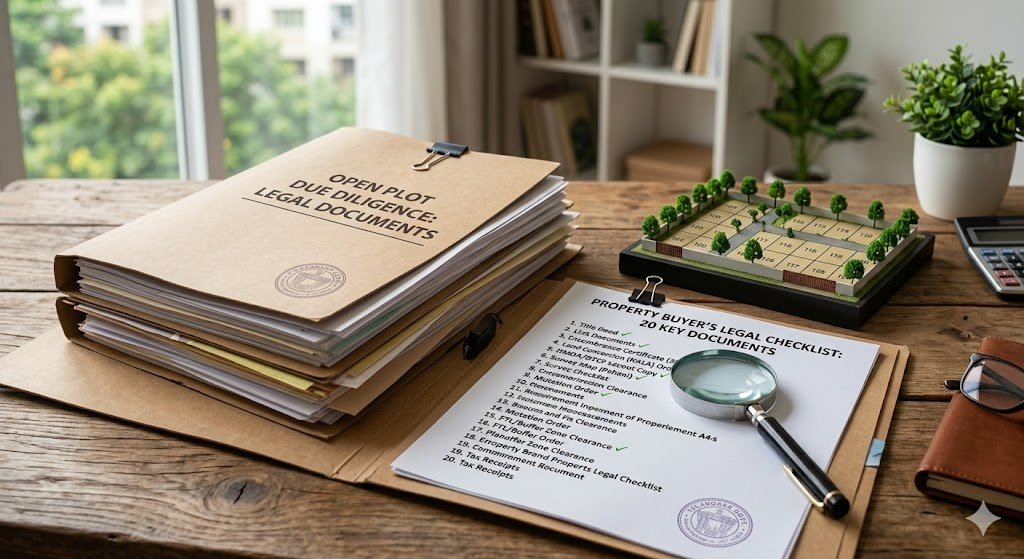
The “20-Point” Printable Checklist
Don’t trust your memory. Print this list and tick the boxes.
- 1. [ ] Title Deed (Sale Deed) – In the name of the seller.
- 2. [ ] Link Documents – Flow of title for 30 years.
- 3.[ ] Encumbrance Certificate (EC) – 30 years history.
- 4. [ ] Pattadar Passbook – Matches Bhu Bharati record.
- 5. [ ] Layout Copy – DTCP/HMDA approved (with seal).
- 6. [ ] NALA Order – Conversion to Non-Agri use.
- 7. [ ] Land Use Certificate – Residential Zone check.
- 8. [ ] Mortgage Release Letter – Only for layout plots.
- 9. [ ] FTL/Buffer Zone Map – Lake clearance.
10. [ ] 1B ROR Extract – Revenue record match. - 11. [ ] Prohibited List Check – Section 22A status.
- 12. [ ] Adangal/Pahani – Current year crop/land status.
- 13. [ ] Khasra Pahani – 1954-55 verification.
- 14. [ ] Sethwar – Boundary map verification.
- 15. [ ] Mutation Proceedings – Order copy.
- 16. [ ] NOC from Family Members – If inherited property.
- 17. [ ] Tax Receipts – If applicable.
- 18. [ ] Aadhaar/PAN of Seller – Identity check.
- 19. [ ] Topo Sketch – Survey map of the specific plot.
- 20. [ ] Physical Survey Report – Measure the actual land.
Final Advice: Buying land is the biggest investment of your life. Don’t save ₹10,000 on a lawyer. Take these documents to a property lawyer for a legal opinion. It is cheaper to pay a lawyer now than to fight a court case for 20 years

