
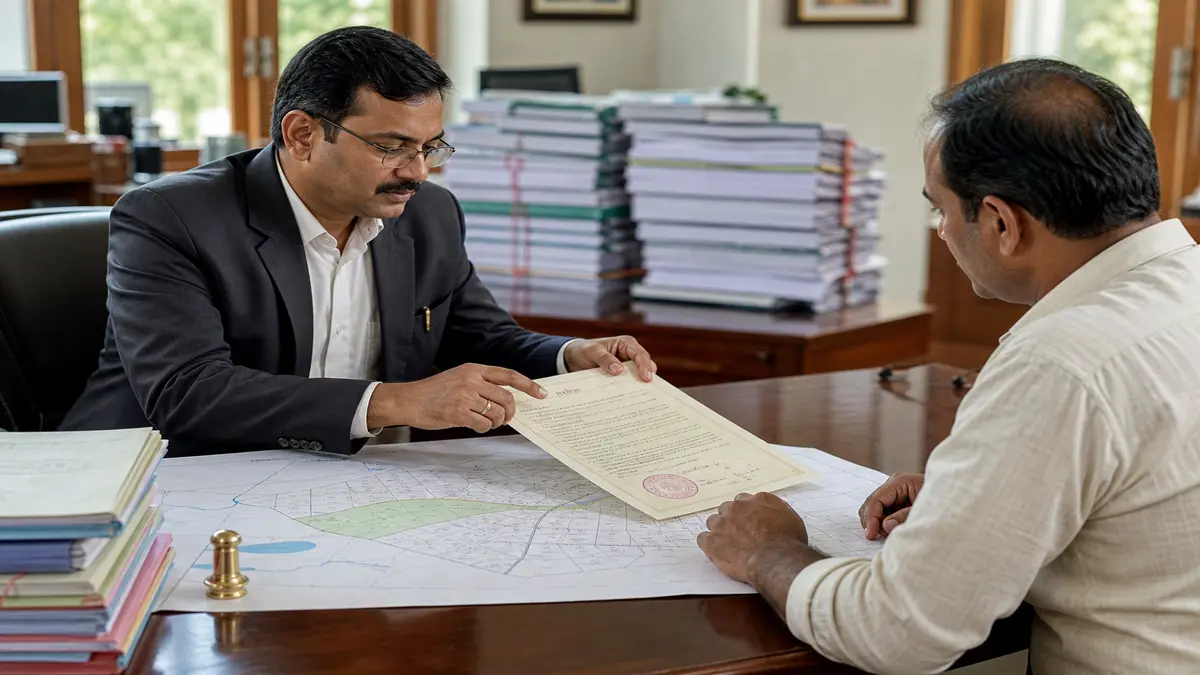
Imagine finalizing a beautiful 200-square-yard residential plot near Shamshabad, only to arrive at the Sub-Registrar Office and realize your budget is short by lakhs. Many property buyers calculate their stamp duty based on the actual agreed sale price with the seller. However, the government calculates Registration Fees based on the official market value or circle rate, whichever is higher. When the 2026 revised sub-registrar values hit the portal, hundreds of buyers found their pre-calculated budgets completely derailed. Land registration is not just a mere signature on paper. It involves a strict calculation of stamp duty, transfer duty, and user charges mandated under the Indian Stamp Act, 1899. Paying these exact government charges is the only way your sale deed gains legal validity in a court of law. Without a registered deed, securing a Pattadar Passbook or getting a mutation done on the Bhu Bharati portal is legally impossible. This guide explains exactly how property registration fees work in Telangana for 2026, how to calculate your exact stamp duty, and the complete process to register your land deeds online without facing rejection.
| Detail | Info |
|---|---|
| Governing Body | Registration and Stamps Department, Government of Telangana |
| Official Portal | registration.telangana.gov.in / bhubharati.telangana.gov.in |
| Applicable State | Telangana |
| Act Reference | Indian Stamp Act, 1899 & Telangana Rights in Land Act, 2020 |
| Registration Fees | 0.5% of market value |
| Processing Time | Same day for standard deeds |
| Helpline / Contact | 1800 599 4788 |
| Last Updated | 2026 |
“Never finalize a property purchase budget without checking the latest official circle rates online, as government registration values often surpass your actual transaction price.”
What Are Telangana Property Registration Fees?
Property registration fees in Telangana are mandatory statutory charges paid to the state government to legally record a property transfer. As of 2026, the standard total cost is 7.5% for sale deeds. This total comprises a 5.5% stamp duty, a 1.5% transfer duty levied by local civic bodies, and a 0.5% final registration fee calculated on the property’s market value.
Whenever ownership of a piece of land, flat, or commercial space changes hands, the transaction must be recorded in the government ledgers. The Registration and Stamps Department maintains these public records. By paying the required stamp duty, your property document transforms from a simple written agreement into a legally binding public record. If a dispute ever arises regarding ownership, only a properly stamped and registered document is admissible as evidence in Indian civil courts.
The calculation of these fees relies entirely on the basic value register maintained by the Sub-Registrar. If you buy a property for ₹50 lakhs, but the government’s basic value for that area dictates the property is worth ₹80 lakhs, you must pay the 7.5% fee on the ₹80 lakh valuation. Paying anything less triggers a legal notice under Section 47A for undervaluation. Understanding this distinction saves buyers from severe legal penalties and delayed document processing.
Objectives and Benefits of Paying Stamp Duty
Many buyers view stamp duty purely as a financial burden. However, paying this fee serves critical legal functions for your property ownership.
- Establishes clear, undisputed legal title in the buyer’s name.
- Makes the sale deed legally admissible in any civil court or revenue tribunal.
- Triggers the automatic updating of Encumbrance Certificates (EC) to reflect your ownership.
- Generates essential revenue for the state government to fund civic infrastructure.
- Prevents backdated fraudulent property transfers by recording the exact time of registration.
For landowners and buyers, the practical benefits extend beyond mere legality.
- Allows buyers to secure home loans or mortgage the property against bank credit.
- Enables smooth mutation of agricultural records on the Bhu Bharati portal.
- Ensures you receive compensation if the government ever acquires your land for highways or projects.
- Protects against double registrations, as the system flags properties that already have an active registered deed.
- Makes it much easier to sell the property in the future with a clean, unbroken chain of title.
Who Needs to Pay Property Registration Fees?
The requirement to pay stamp duty applies to almost every type of property transfer, though the exact percentage varies based on the transaction type.
| Category | Applicable | When Required |
|---|---|---|
| Property Buyers | Yes | When executing a standard sale deed for plots, flats, or agricultural land. |
| Family Members | Yes | When registering a gift deed or settlement deed among blood relatives. |
| Legal Heirs | Yes | When registering a formal partition deed among joint family members. |
| Lenders and Banks | Yes | When registering a mortgage deed or deposit of title deeds for a home loan. |
| Developers | Yes | When executing a Development Agreement cum General Power of Attorney (DAGPA). |
Documents Required for Property Registration
Presenting incomplete documents is the most common reason Sub-Registrars reject or delay a registration. Both buyer and seller must bring specific original files to the office.
| Document | Who Submits |
|---|---|
| Original Link Documents (Previous Deeds) | Seller |
| Latest Encumbrance Certificate (EC) | Seller |
| Pattadar Passbook (for agricultural land) | Seller |
| Aadhaar Cards and PAN Cards | Both Parties |
| Latest Property Tax Receipt | Seller |
| Challan for Stamp Duty Payment | Buyer |
| Two Passport Size Photographs | Both Parties |
| Section 32A Form (Biometric Consent) | Both Parties |
Pro Tip
Always ensure your name on the Aadhaar card perfectly matches the name printed on the Pattadar Passbook or old sale deed. Even a minor spelling mismatch will cause the biometric system to reject your application at the Sub-Registrar office.
Current Stamp Duty and Registration Fees (2026 Update)
The Telangana government frequently updates the basic values of properties. However, the percentage rates applied to different types of deeds remain relatively stable. Here is the exact fee structure you must follow in 2026.
| Service | Fee (Telangana) | Comparison State (AP) |
|---|---|---|
| Sale Deed | 7.5% total (5.5% Stamp + 1.5% Transfer + 0.5% Reg) | 7.5% total |
| Gift Deed (Family) | 2.0% total (1.5% Stamp + 0.5% Transfer) | 2.0% total |
| Gift Deed (Non-Family) | 7.5% total | 7.5% total |
| Partition Deed | 1.0% (Max ₹10,000) + ₹1,000 Reg Fee | 1.0% total |
| Mortgage Deed | 0.5% (Max ₹50,000) | 0.5% total |
| General Power of Attorney (GPA) | 1.0% of Market Value | 1.0% total |
| Will Registration | No Stamp Duty + ₹1,000 Reg Fee | ₹1,000 Reg Fee |
How to Calculate Fees on the Registration Portal
You do not need to guess your registration costs. The Telangana Registration and Stamps Department provides a direct online calculator. First, you must identify the correct market value. Navigate to the official portal and locate the ‘Market Value Search’ option. Enter your district, mandal, and village. The system will display the per-square-yard or per-acre rate fixed by the government for 2026.
Once you have this basic value, multiply it by your total property area. This gives you the official assessment value. If your actual sale consideration (the money you are paying the seller) is higher than this assessment value, the fees will be calculated on your sale consideration. You then apply the 7.5% total charge to this highest figure. Generating the payment challan requires this exact calculation. Overpaying results in a lengthy refund process, while underpaying leads to immediate document rejection.
Step-by-Step Property Registration Process
Registering property in Telangana is now a highly digitized process. Gone are the days of carrying cash to the Sub-Registrar office. You must complete the pre-registration steps online.
Determine Market Value
Visit the official Registration and Stamps portal. Use the ‘Market Value Search’ tool to find the exact per-square-yard rate for your specific locality and street.
Draft the Sale Deed
Hire a certified document writer or legal expert to draft your deed. Ensure all survey numbers, boundaries, and payment details match the revenue records exactly.
Generate the e-Challan
Log into the portal and create an e-Challan for the exact stamp duty, transfer duty, and registration fee amount. Pay this amount via net banking or authorized bank branches.
Book a Registration Slot
Use the Public Data Entry (PDE) system to enter buyer and seller details. Upload the payment challan and select an available date and time slot at your local Sub-Registrar office.
Appear for Biometrics
Both parties, along with two witnesses, must visit the office at the allotted time. The officer will capture photographs and biometric thumb impressions through the Aadhaar database.
Document Scanning and Issuance
The officer verifies the draft, stamps the document with a unique registration number, and scans the entire deed into the central server. The original is returned to the buyer.
Initiate Mutation
For agricultural lands, the registration data automatically flows to the Bhu Bharati portal. For urban properties, apply separately to the local municipality for name transfer.
Common Errors During Fee Payment and Registration
Even a small clerical mistake can delay your property transfer by months. Knowing the pitfalls saves you from endless visits to the revenue office.
| Common Error | How to Correct It | Authority Involved |
|---|---|---|
| Wrong Survey Number on Deed | Execute and register a Rectification Deed | Sub-Registrar |
| Under-valuation of Property | Pay the deficit stamp duty upon receiving notice | District Registrar |
| Aadhaar Biometric Failure | Update biometrics at Aadhaar center and re-apply | UIDAI / Sub-Registrar |
| Missing Link Documents | Apply for a certified copy of the missing deed | Registration Portal |
| Wrong Challan Head Account | Apply for challan cancellation and generate a new one | Treasury Department |
Watch Out
Never attempt to lower your stamp duty by showing a commercial property as a residential one in the deed. Sub-Registrars conduct field inspections. If caught, you will face a Section 47A case, heavy penalties, and your document will be impounded until the deficit is paid.
Timeline for Deed Processing and Delivery
The Telangana government has mandated swift processing for transparent property transactions. If your documents are perfect and your slot is booked, the actual registration at the office takes less than an hour. The Sub-Registrar captures biometrics, verifies the challan, and issues the registered document on the same day. However, if your property valuation is contested, or if the server faces technical downtime, the process can drag on.
For agricultural lands registered through the Bhu Bharati platform, the mutation happens almost simultaneously with the registration. The Tahsildar acts as the Joint Sub-Registrar. Once the deed is registered, the digital Pattadar Passbook is updated instantly, and the physical passbook is dispatched via post within two weeks. Urban property mutations take longer, often requiring 15 to 30 days after registration to reflect in the municipal tax records.
Exemptions and Concessions on Fees
The government offers specific concessions to encourage legal family settlements and support marginalized groups. Blood relatives transferring property via a gift deed or settlement deed enjoy a drastically reduced rate. Instead of the crushing 7.5% fee, a family gift deed only attracts a 2% total charge. This is designed to prevent messy legal battles by encouraging elders to formally register property distributions during their lifetime.
Similarly, partition deeds among joint family members have a capped stamp duty structure. Rather than paying a percentage of the total property value, families pay a nominal fee of 1% subject to a maximum cap of ₹10,000, plus a minor registration charge. Furthermore, specific government-allotted lands for below-poverty-line families often carry total stamp duty exemptions when the initial patta is granted, though subsequent sales (after the lock-in period) attract standard rates.
Landowner and Buyer Legal Rights
You have specific rights under the Indian Stamp Act and the Telangana land revenue framework. Do not let touts or middlemen convince you otherwise.
- Right to Transparent Valuation: You have the right to view the official basic value register online before drafting your document.
- Right to Appeal: If issued a 47A notice for undervaluation, you can appeal to the District Registrar to challenge the assessment.
- Right to Same-Day Delivery: Under normal circumstances, you have the right to receive your scanned, registered document on the same day.
- Right to Refund: If a transaction fails or is cancelled before registration, you can claim a refund of your unutilized stamp duty challan within six months.
- Right to Digital Records: You have the right to download a certified copy of your registered deed and Encumbrance Certificate directly from the portal.
5 Things Every Buyer Must Know About Registration Fees
- Total Burden is 7.5%
The standard fee combines stamp duty, transfer duty, and user charges into one lump sum payment.
- Circle Rates Rule
You must pay fees based on the government’s basic value, even if you bought the land for a cheaper price.
- Section 47A Danger
Hiding commercial usage to pay residential rates will result in your document being seized by the government.
- Challan Expiry
A generated stamp duty e-Challan is typically valid for a limited period; book your slot before it expires.
- Family Concessions
Transferring property to blood relatives via gift deed costs significantly less than executing a standard sale deed.
Did You Know?
If you execute a property sale agreement outside India, you have exactly three months from the date the document arrives in India to present it to a Sub-Registrar and pay the stamp duty, otherwise it loses its legal validity entirely.
Reality Check: What This Portal Cannot Fix For You
While the Telangana property registration system is heavily digitized, it is not flawless. Many buyers assume that paying the fees online and getting a slot guarantees a smooth registration. This is not true. If the legacy data pushed from the old manual ledgers to the digital portal contains a spelling mistake in your seller’s name, the system will block the registration. The portal cannot auto-correct legacy data. You must endure a manual correction process through the Tahsildar before you can register the new deed.
Civil court stays create another massive invisible hurdle. The portal does not always update civil court injunctions in real-time. You might successfully generate a challan and pay lakhs in stamp duty, only for the Sub-Registrar to reject your deed at the counter because a physical court order was just delivered to their office. Your money gets stuck in the treasury until you apply for a complex refund process.
Server downtime is a harsh reality. On days when the central Aadhaar authentication server or the state treasury payment gateway is down, your booked slot becomes useless. You will be forced to wait at the office or re-book for another day. No amount of arguing with the local staff can bypass a central server outage.
Finally, the portal cannot verify ground reality. The digital system might accept your fees for a flat empty plot based on old records. But if the Sub-Registrar decides to do a physical field inspection and finds an unapproved structure on that land, they will halt the registration. The digital system does not replace the revenue department’s right to physically verify the asset.
Watch Out
The biggest mistake buyers make is paying the full stamp duty challan without pulling a fresh Encumbrance Certificate on the very morning of registration. A surprise prior registration by a fraudulent seller can block your deed, leaving your challan money trapped.
State Comparison: Telangana vs Andhra Pradesh vs Karnataka
Registration fees vary significantly across South Indian states. If you are an investor looking across borders, understanding these differences is crucial for budget planning.
Stamp Duty Comparison 2026
| Factor | Telangana | Andhra Pradesh |
|---|---|---|
| Total Sale Deed Fee | 7.5% | 7.5% |
| Family Gift Deed | 2.0% | 2.0% |
| Women Concession | No special concession | No special concession |
| Agriculture Mutation | Instant via Bhu Bharati | Requires separate Meebhoomi application |
Expert Tip
If you receive a Section 47A notice for undervaluation, do not ignore it. The District Registrar has the power to attach your other bank accounts or properties to recover the deficit stamp duty. Always consult a revenue lawyer to file a proper appeal within the stipulated 30-day window.
Official Land Records Resources
Always use the official government portals for calculating fees and booking slots. Beware of lookalike websites that charge unauthorized convenience fees.
| Resource | Purpose | URL (plain text) |
|---|---|---|
| Telangana Registration Dept | Fee Calculation & Slots | registration.telangana.gov.in |
| Bhu Bharati Portal | Ag Land Registration & Records | bhubharati.telangana.gov.in |
| Meebhoomi Portal | AP Land Record Verification | meebhoomi.ap.gov.in |
Frequently Asked Questions
What are the current property Registration Fees in Telangana?
As of 2026, the total property registration fees in Telangana amount to 7.5% of the property’s market value. This includes 5.5% stamp duty, 1.5% transfer duty, and a 0.5% registration charge. This applies to standard sale deeds for both agricultural and urban properties.
How do I calculate stamp duty for my property?
You can calculate it by checking the basic market value of your locality on the official Registration and Stamps portal. Multiply this per-square-yard rate by your total area. Apply the 7.5% fee to this total official value, or your actual sale price, whichever is higher.
Can Registration Fees be refunded if a deal cancels?
Yes, if a property transaction falls through before the document is registered, you can apply for a refund of the unused stamp duty challan. The application must be submitted online to the District Registrar within six months, and a small deduction usually applies.
Are there lower Registration Fees for women in Telangana?
Unlike some northern states that offer a 1% or 2% rebate on stamp duty for properties registered in a woman’s name, Telangana currently does not offer gender-based concessions. The standard 7.5% rate applies regardless of the buyer’s gender.
What is the fee for gifting property to a family member?
Gifting property to blood relatives (parents, children, spouse, siblings) attracts a heavily concessional rate. Instead of the standard 7.5%, a family gift deed in Telangana only requires a 2% total fee (1.5% stamp duty and 0.5% transfer duty).
What happens if I underpay the stamp duty?
If the Sub-Registrar suspects you have undervalued the property to save money, they will register the document but immediately impound it under Section 47A. You will receive a legal notice to pay the deficit amount, failing which the document remains invalid.
Need Help with a Land Records Issue?
Whether you are checking a Pahani entry, tracking a mutation application, or verifying a patta — our team can guide you to the right resource.
Chat with us on WhatsApp or email us at [email protected]
Download the BigProperty App to check land record status, track mutation applications, and get property alerts in Hyderabad.

