
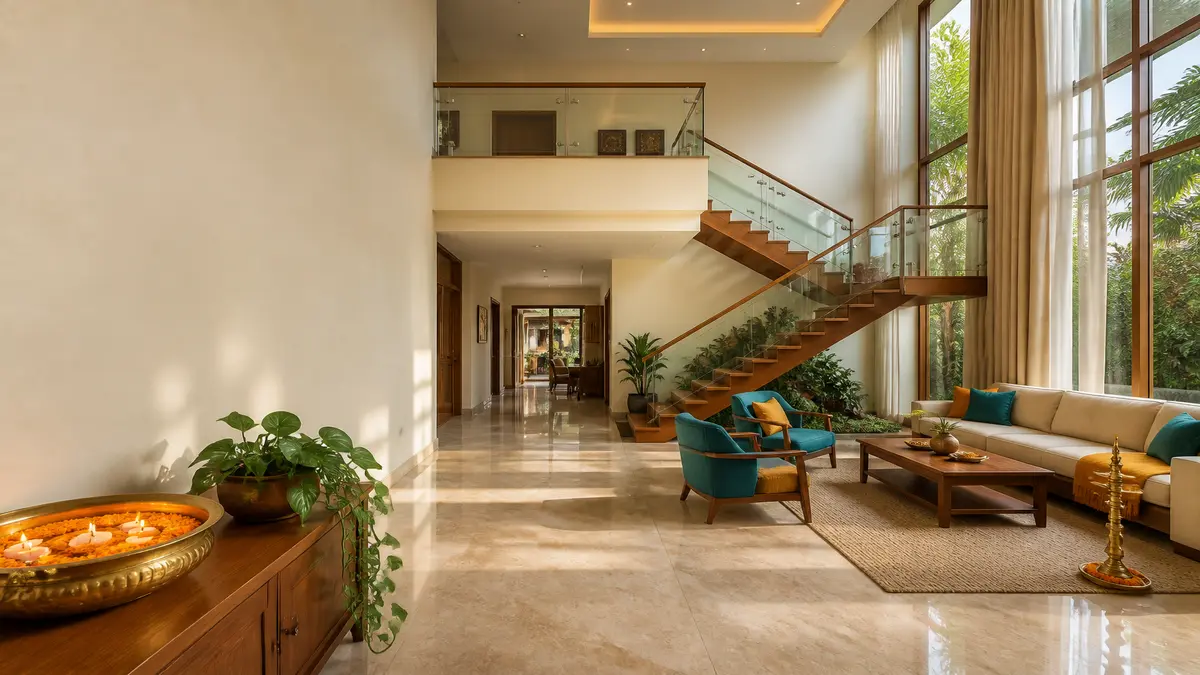
Imagine moving into a spacious new two-story home in Hyderabad, only to feel a subtle disconnect between the upper and lower floors. When a home spans multiple levels, arranging the space becomes more complex than a standard flat. Understanding Vastu for Duplex House layouts is traditionally believed to harmonise the energy flowing between floors and create a unified, peaceful environment.
In a duplex, the internal staircase acts as the primary channel for energy, connecting the active ground floor with the private upper levels. If this vital bridge or the main entrance is placed incorrectly, it can disrupt the natural flow of light, ventilation, and positivity. Applying simple Vastu Shastra principles ensures that the dual-level structure supports your family’s well-being rather than causing energetic imbalances.
This guide simplifies complex Vastu principles to help you design a balanced and prosperous duplex home, covering everything from staircase placement to master bedroom alignment.
| Detail | Info |
|---|---|
| Best Entrance Direction | North, East, or North-East |
| Directions to Avoid | South-West, South-East |
| Ruling Element | Space (Brahmasthan) and Earth elements |
| Best Colors | Light yellow, cream, white, pastel green |
| Key Remedy | Brass pyramids near staircases or sea salt bowls for bad toilet placement |
| Last Updated | 2026 |
“A well-planned staircase acts as an energetic bridge, allowing positive vibrations to flow seamlessly from the ground floor to the rooms above.”
What is Vastu for Duplex Houses?
Vastu for a duplex house focuses on balancing energy across two internal levels connected by a staircase. It involves positioning active zones like the living room and kitchen on the ground floor, while dedicating the upper floor to private spaces like the master bedroom, ensuring a stable and positive flow of energy throughout the entire home.
Unlike a single-floor apartment, a duplex naturally separates public and private life. Traditionally, Vastu aligns this structural reality with cosmic elements. The ground floor represents the earth element, grounding the household’s social and financial activities. The upper floor represents the space and air elements, supporting rest, spiritual growth, and personal privacy.
The Brahmasthan (center of the house) is particularly critical in a duplex. Keeping this central axis clear on both the ground and first floors allows natural light and air to circulate freely. When a duplex is mapped correctly, it is believed to invite long-term prosperity, strong family bonds, and excellent health.
Which Direction Is Best for a Duplex House Entrance?
The main entrance is the mouth of the house, where energy, light, and opportunities enter. For a duplex, the direction of the main door sets the energetic tone for both floors.
| Direction | Effect (as per Vastu) | Remedy If Placed Here |
|---|---|---|
| North / North-East | Highly auspicious; believed to attract wealth, fresh morning light, and positivity. | Keep the entrance clutter-free and brightly lit. |
| East | Excellent for health and vitality; welcomes the morning sun. | Place a copper sun wall hanging above the door. |
| South | Can be balanced if placed in specific auspicious Padas (zones). | Follow specific South Facing House Vastu Tips like adding a red doormat. |
| West | Brings steady gains and stability over time. | Use a brass nameplate and ensure the door is heavy. |
| South-West | Generally avoided; believed to bring struggles and block positive energy. | Place lead metal pyramids or a Panchmukhi Hanuman tile near the door. |
Where Should You Place the Stairs in a Duplex?
The staircase is the defining feature of a duplex house. Since it connects the earth element of the lower floor to the space element above, its placement is crucial.
- Step 1 — Choose the Right Zone: Traditionally, the ideal directions for a staircase are the South, West, or South-West zones. These directions hold heavier energy, and the weight of the stairs helps balance the house.
- Step 2 — Determine the Turning Direction: Always design the stairs to turn in a clockwise direction as you go up. This aligns with the natural rotation of the earth and is believed to promote positive energy flow.
- Step 3 — Count the Steps: Vastu recommends an odd number of steps (e.g., 15, 17, 19, or 21). It is said that when you start climbing with your right foot, an odd number ensures you finish on the upper floor with your right foot, symbolising a positive arrival.
- Step 4 — Avoid the Center (Brahmasthan): Never build the staircase directly in the center of the home. This blocks the core energy center and can make the home feel cramped and heavy.
- Step 5 — Check the Under-Stair Area: Leave the space under the stairs open or use it for general storage. Avoid building a pooja room, kitchen, or toilet directly underneath the staircase.
Ideal Locations for Living Room and Kitchen in a Duplex
The ground floor of a duplex is the social hub of the home. According to Vastu, placing the living room in the North, East, or North-East welcomes positive vibrations and early morning sunlight, keeping the space vibrant for guests and family gatherings.
The kitchen, governed by the fire element (Agni), should ideally be placed in the South-East corner of the ground floor. If South-East is unavailable, the North-West is a practical alternative. Ensure that whoever is cooking faces East, as this is believed to infuse the food with healthy, positive energy. Always keep the kitchen clean and well-ventilated to prevent stagnant odors from drifting to the upper floors.
Vastu Guidelines for Master Bedrooms and Toilets
A duplex offers the luxury of moving private spaces to the upper level. The master bedroom is best located on the first floor in the South-West corner. This zone is traditionally associated with the earth element, providing stability, deep rest, and leadership for the head of the family. If there are elderly parents living with you, it is practical to provide them with a bedroom on the ground floor (ideally in the South or West) to avoid the physical strain of climbing stairs.
For toilets, placement is critical. Bathrooms should ideally be in the West or North-West zones of the respective floors. A major rule in duplex Vastu is to ensure that a toilet on the upper floor is never located directly above the ground floor kitchen, pooja room, or the main entrance, as this is believed to contaminate the positive energy below.
Essential Vastu Dos and Don’ts for Your Home
| Do | Don’t |
|---|---|
| Keep the Brahmasthan (center) clear on both floors. | Don’t place heavy furniture or stairs in the center. |
| Use light, pastel colors on the walls. | Don’t use dark or aggressive colors like black or deep red. |
| Ensure cross-ventilation between the two floors. | Don’t block the North and East windows. |
| Keep the upper floor balcony in the North or East. | Don’t build heavy balconies in the South or South-West. |
| Use square or rectangular shapes for room layouts. | Don’t opt for irregular or heavily cut-corner room designs. |
| Place the Pooja room on the ground floor in the North-East. | Don’t build a toilet directly above or adjacent to the Pooja room. |
Pro Tip
If you are renting a duplex and cannot change the staircase direction or toilet placement, keep the doors of incorrectly placed bathrooms closed at all times and place a small bowl of uncrushed sea salt inside to absorb negative vibrations. Change the salt weekly.
Colors and Materials for a Harmonious Duplex
Colors significantly impact the mood and perceived size of a multi-story home. In Vastu, colors are linked to natural elements and directions. Using the right palette ensures the home feels airy and connected rather than divided and dark.
- Recommended Colors: Light yellow, cream, off-white, and pastel green. These reflect natural light beautifully, making both floors look spacious and serene.
- Colors to Avoid: Avoid painting entire walls in black, dark grey, or intense red. These colors absorb light, can make staircases feel claustrophobic, and are believed to trigger agitation.
- Materials: Opt for natural materials like wood and stone. A wooden handrail on the staircase is highly recommended as wood represents growth and vitality.
How to Identify and Remedy Common Vastu Doshas
Even a well-planned duplex might have minor architectural flaws (doshas). Fortunately, Vastu provides simple, non-destructive remedies to balance the energy.
- Staircase in the North-East: The North-East should be light and open. If stairs are here, place a copper or brass Vastu pyramid near the base and keep a vibrant money plant nearby to uplift the energy.
- Toilet Above the Kitchen: This is a major defect. If it cannot be relocated, place a Vastu energy partition (or a false ceiling with Vastu crystals) between the two floors. Keep a bowl of camphor in the bathroom.
- Anti-Clockwise Stairs: If your stairs turn left (anti-clockwise), hang a bright, positive painting on the staircase wall and ensure the area is brilliantly illuminated with warm lights to counteract the imbalance.
- Main Door Facing South-West: Place two auspicious plants (like Tulsi or Jade) near the entrance and ensure the area is always well-lit.
Watch Out
The single most common mistake in modern duplexes is building a powder room (half-bathroom) directly under the main internal staircase to save space. Vastu strictly advises against this, as the staircase represents progress, and placing a drain beneath it is believed to wash away financial stability.
Believed Benefits of a Vastu-Compliant Duplex
When a duplex is arranged according to Vastu Shastra, it creates a living environment that supports the occupants physically and mentally.
- Believed to foster family harmony: Proper zoning separates noisy social areas from quiet resting areas, reducing domestic friction.
- Traditionally associated with financial stability: Placing the master bedroom in the South-West is said to give the breadwinner a sense of control and groundedness.
- Believed to improve physical health: Keeping the center open and placing the kitchen in the fire zone promotes excellent cross-ventilation and safe cooking environments.
- Believed to invite positive opportunities: A clutter-free, well-lit North-East entrance acts as a magnet for good fortune and clear thinking.
Common Myths About Duplex Vastu Debunked
Myth: Duplex houses are generally bad for Vastu.
What Vastu actually says: Duplexes are not inherently bad. In fact, ancient palaces and mansions were multi-leveled. As long as the heavy structures (stairs, master suite) are in the South/West and the light areas are in the North/East, a duplex is highly auspicious.
Myth: The staircase must be located outside the house.
What Vastu actually says: Internal staircases are perfectly acceptable and very common in modern duplexes. They only need to be placed in the correct zones (South, West, South-West) and avoid the exact center of the home.
5 Vastu Rules Everyone Gets Wrong About Duplex Houses
-
The Staircase Myth
Stairs don’t have to be outside; they just shouldn’t be in the exact center (Brahmasthan).
-
The Upper Floor Balcony
Balconies should ideally be in the North or East, not the South-West.
-
Under the Stairs Space
Never build a pooja room or toilet under the stairs; use it for general storage only.
-
Floor Zoning
Active zones (kitchen, living) belong on the ground floor; resting zones (master bedroom) belong upstairs.
-
Toilet Overlaps
A first-floor bathroom should never sit directly above a ground-floor kitchen.
Reality Check: Vastu Is a Guide, Not a Guarantee
Vastu Shastra is an ancient, traditional belief system designed to harmonize human dwellings with nature. Many of its rules are rooted in profound architectural common sense. For instance, recommending that the North and East remain open allows homes in India to capture the gentle morning sunlight, while placing heavy staircases in the South and West blocks the harsh afternoon heat. These are practical design choices as much as they are spiritual ones.
However, it is vital to remember that a home that breaks a Vastu rule is not doomed to failure. Modern architecture, space constraints, and apartment layouts often make strict compliance impossible. If your staircase is in the North-East or your duplex entrance faces South-West, practical remedies like lighting, colors, and mirrors can easily balance the space without requiring demolition.
Ultimately, a home should be judged on its structural safety, legal clarity, ventilation, and the joy it brings your family. Buyers should never reject a structurally sound, beautifully built duplex based on Vastu alone without weighing all practical factors and considering easy, sensible remedies.
Comparing Vastu: Single Floor vs Duplex House
| Factor | Single Floor Home | Duplex House |
|---|---|---|
| Energy Flow | Flows horizontally across one plane. | Flows horizontally and vertically via the staircase. |
| Brahmasthan (Center) | Only needs to be kept clear on one level. | Must be kept clear on both the ground and first floors. |
| Master Bedroom | Placed in the South-West of the entire plot. | Placed in the South-West on the uppermost floor. |
| Privacy Zoning | Harder to separate public and private spaces. | Naturally separates public (ground) from private (first floor). |
Expert Tip
To enhance the connectivity and positive energy between floors, hang a beautiful, well-lit family portrait or a painting of a scenic landscape on the main wall of the staircase landing. Avoid hanging mirrors here, as they can visually reflect energy back down the stairs.
Frequently Asked Questions
Is a duplex house considered good according to Vastu Shastra?
Yes, a duplex is considered very auspicious if planned well. The multi-level structure allows for excellent segregation of active spaces (kitchen, living) on the ground floor and peaceful spaces (bedrooms) on the upper floor, naturally supporting family harmony and privacy.
Where should the staircase be located in a duplex house?
According to Vastu, the best directions for an internal staircase are the South, West, or South-West zones. The stairs should ideally turn in a clockwise direction as you ascend, and they should never be placed exactly in the center of the home.
Can the kitchen be placed directly above or below a bathroom?
No, Vastu strongly advises against placing a kitchen directly above or below a bathroom. This is believed to mix the pure fire energy of the kitchen with the waste energy of the toilet, potentially causing health and financial issues. If this exists, keep the bathroom door closed and use Vastu remedies.
What is the best direction for the main entrance of a duplex?
The most favorable directions for the main entrance of a duplex are North, East, and North-East. These directions welcome early morning sunlight and are traditionally believed to bring prosperity, health, and positive vibrations into the home.
How can I correct Vastu defects in my existing duplex?
You can correct Vastu defects using simple, non-structural remedies. For example, use sea salt bowls in incorrectly placed toilets, place brass pyramids near stairs in the wrong zone, ensure ample lighting in dark corners, and use East Facing House Vastu Tips like placing plants to balance energy.
Does a duplex have specific Vastu rules compared to a single-floor home?
Yes, duplexes have specific rules regarding vertical energy flow. The placement of the staircase, the alignment of rooms above one another (like not having a bedroom above a kitchen), and keeping the center open on multiple levels are unique considerations for duplex homes.
Looking for a Vastu-Friendly Property in Hyderabad?
From east-facing plots to Vastu-compliant apartments — explore verified listings on BigProperty.in, or ask us directly.
Chat with us on WhatsApp or email [email protected]
Download the BigProperty App for property alerts, verified plots and Vastu-tagged listings in Hyderabad.

