
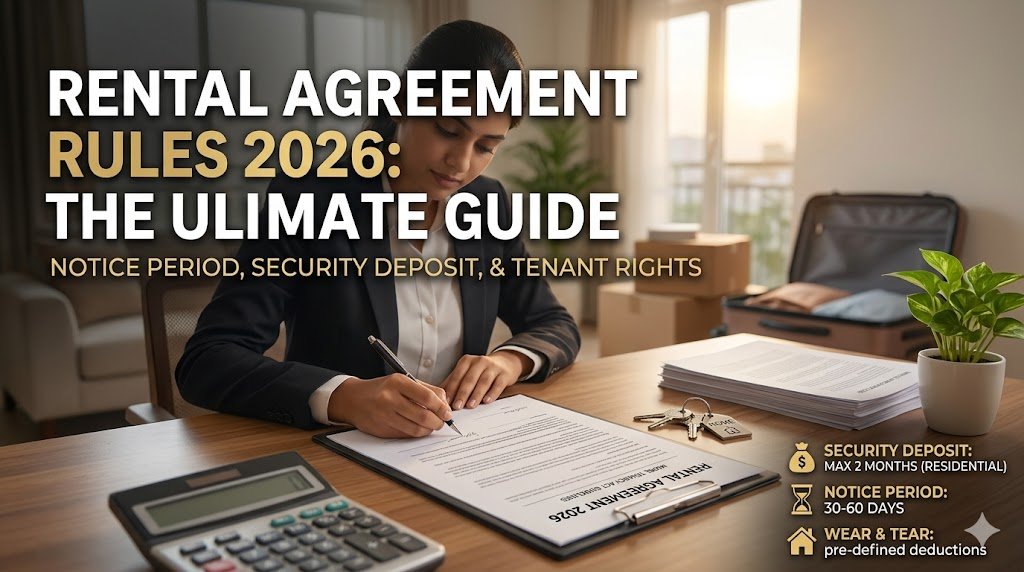
Every Indian tenant knows the anxiety of renting a new house. The excitement of moving into a beautiful 3BHK in Hyderabad or Bangalore is almost instantly crushed when the landlord hands over a highly one-sided rental agreement demanding a massive 10-month security deposit.
For decades, the Indian rental market operated on unwritten rules heavily skewed in favor of property owners. Tenants dealt with arbitrary rent hikes, withheld deposits, and sudden eviction notices. However, with the widespread implementation of the Model Tenancy Act (MTA) guidelines across states by 2026, the legal landscape has finally shifted.
Whether you are a landlord looking to draft a foolproof contract or a tenant trying to protect your hard-earned money, here is the absolute ground reality of rental agreement rules in India for 2026.
2026 Rental Agreement: Quick Legal Facts
Before signing on the dotted line, ensure your 11-month agreement aligns with these standard guidelines.
| Rental Clause | 2026 Standard / MTA Guideline | What to Strictly Avoid |
| Security Deposit (Residential) | Maximum 2 Months Rent | 6 to 10 months demand |
| Security Deposit (Commercial) | Maximum 6 Months Rent | Arbitrary, undefined amounts |
| Notice Period | 30 to 60 Days (Mutual) | 0-day immediate eviction clauses |
| Standard Lock-in Period | 6 Months | 11-month rigid lock-ins |
| Annual Rent Escalation | 5% to 10% (Pre-defined) | “As per owner’s discretion” |
| Agreement Registration | Mandatory if over 11 months | Unregistered verbal agreements |
1. The Security Deposit Myth (Breaking the 10-Month Rule)
If you are renting in cities like Bengaluru, Chennai, or parts of Hyderabad’s IT corridor, landlords historically demanded an exorbitant 6 to 10 months’ rent as a security deposit upfront.
The 2026 Legal Reality: Under the principles of the Model Tenancy Act, demanding a 10-month deposit for residential properties is legally obsolete. The act strictly caps the security deposit for residential premises at a maximum of two months’ rent. For commercial properties, it is capped at six months.
How to Handle This: If a landlord demands a massive deposit, politely reference the MTA guidelines. In highly competitive micro-markets (like Tellapur or Whitefield), owners might still push back. The modern 2026 compromise that most IT employees are successfully negotiating is a 3-to-4-month deposit. Never hand over 10 months’ rent—it is dead capital that earns you no interest and is notoriously difficult to recover.
2. Lock-in Period vs. Notice Period (Know the Difference)
One of the most common reasons tenants lose their security deposit is misunderstanding the difference between the “Lock-in” and the “Notice” period.
- The Lock-in Period: This is the minimum duration you are legally bound to stay in the property (standard is 6 months). If you vacate before the lock-in period ends, the landlord has the legal right to deduct the rent for the remaining lock-in months directly from your security deposit.
- The Notice Period: This is the advance intimation you must give the owner before vacating (standard is 30 to 60 days).
The Golden Rule: You cannot use your notice period to bypass your lock-in period. For example, if your lock-in is 6 months, you can only serve your 1-month notice in the 5th month so that you move out exactly at the end of the 6th month.
3. The “Painting and Maintenance” Deduction
The biggest fight between a landlord and tenant happens on the day of vacating. The tenant expects the full deposit back, but the landlord hands over a list of deductions for “damages and painting.”
The 2026 Standard Clause:
Your rental agreement must explicitly state what constitutes “wear and tear.”
Standard agreements today have a fixed clause: A standard deduction of 0.5 to 1 month’s rent will be taken for repainting and deep cleaning upon vacating. If this clause is in your agreement, the landlord cannot randomly deduct ₹50,000 for a few scuff marks on the wall. As a tenant, always take time-stamped photos of every room, fixture, and existing damage on the day you move in, and email them to the landlord. This is your ultimate legal proof against unfair deductions.
4. The “Surprise Rent Hike” Nightmare
Imagine it is a Friday evening. You just got a decent appraisal at your IT job. You are out celebrating with your family, and suddenly, your phone buzzes. It is a WhatsApp message from your landlord: “Rent is increasing by 20% starting next month. Let me know if you want to stay or vacate.”
In a single second, your celebration turns into a panic attack. You are trapped. Moving costs money, but paying a 20% hike breaks your monthly budget. This emotional hostage situation happens to thousands of Indian tenants every single year.
The 2026 Legal Reality: Under the Model Tenancy Act, arbitrary, overnight rent hikes are entirely illegal. A landlord cannot increase the rent during the active tenure of the 11-month agreement. Furthermore, the renewal hike must be predefined in your contract. The current industry standard across major metro cities is a 5% to 8% annual escalation. If your landlord insists on a clause that says, “Rent increase as per owner’s discretion,” refuse to sign it. Lock in that 5% strictly on paper.
5. The “Spare Key” Invasion of Privacy
There is a deeply ingrained myth among older property owners in India that because they own the physical bricks of the house, they can enter it whenever they please. Many tenants have horror stories of waking up on a Sunday morning to find their landlord standing in the living room “checking the plumbing” using a spare key.
The 2026 Legal Reality: The moment you sign a rental agreement, you are paying for exclusive possession and the fundamental right to privacy. Legally, a landlord cannot enter the rented premises without providing a minimum 24-hour prior notice (either written or verbal). Furthermore, visits for repairs or inspections can only happen during reasonable daylight hours (typically between 7:00 AM and 8:00 PM). If a landlord repeatedly enters your home without permission, it is legally considered trespassing.
6. The 30-Day Deposit Return Rule
The day you hand over the keys to a house you have lived in for years is always stressful. You have packed your life into boxes, paid the movers, and now you are desperately waiting for the owner to transfer your ₹1 Lakh security deposit so you can pay the deposit for your next house. But the owner says, “I will check the house thoroughly and send it next month.”
The 2026 Legal Reality: You do not have to wait indefinitely. The legal framework now mandates that the landlord must return the remaining security deposit (after legally agreed deductions for painting or unpaid utility bills) at the time of handing over the vacant possession, or within a maximum of 30 days. Smart Tenant Tip: Do not hand over the physical keys until the final deduction amount is agreed upon in writing (via email or WhatsApp) and the transfer is initiated.
7. Unregistered Agreements Are Useless in Court
Many landlords and tenants try to save a few thousand rupees by skipping the sub-registrar office and simply signing the agreement on a ₹100 stamp paper bought from a local vendor.
The Catch (The Reality Check): If your agreement is for 11 months, a notarized stamp paper is generally acceptable for address proof. However, if your agreement is for 12 months or more, it is legally mandatory to register it at the sub-registrar’s office. If a major dispute arises—say, the landlord refuses to return a massive ₹3 Lakh deposit—a local rent court or grievance redressal officer will likely dismiss your case immediately if the agreement is unregistered, as it holds no evidentiary value. Spend the money to register your agreement; it is your only legal armor.
FAQs: Rental Agreements in India (2026)
Absolutely not. The Model Tenancy Act strictly prohibits landlords from withholding essential supplies (electricity, water, parking, or elevator access) under any circumstances, even if the tenant has defaulted on rent. This is considered illegal harassment. The landlord must approach the Rent Authority to recover dues.
If a specific lock-in period is not explicitly written in the signed rental agreement, it does not legally exist. In such cases, the tenant can vacate the property at any time by simply serving the standard notice period (usually 30 days) without any financial penalty.
Routine maintenance (changing a fused bulb, fixing a minor leaky tap) is the tenant’s responsibility. However, major structural repairs (fixing a burst internal pipe, seepage from the ceiling, rewiring, or major appliance breakdowns not caused by the tenant’s negligence) are entirely the financial responsibility of the landlord.
No. Even if your rental agreement has expired, or you have breached a clause, a landlord cannot forcefully throw you or your belongings out on the street. They must issue a formal legal notice and, if you refuse to leave, file an eviction petition with the local Rent Court.
Looking for Premium, Hassle-Free Rentals in Hyderabad?
Are you an IT professional tired of dealing with unfair landlords? Or an owner seeking verified, high-quality corporate tenants? We make renting completely transparent and legally secure. 👉 Contact Us Here to explore our premium rental listings and property management services in West Hyderabad today.

