
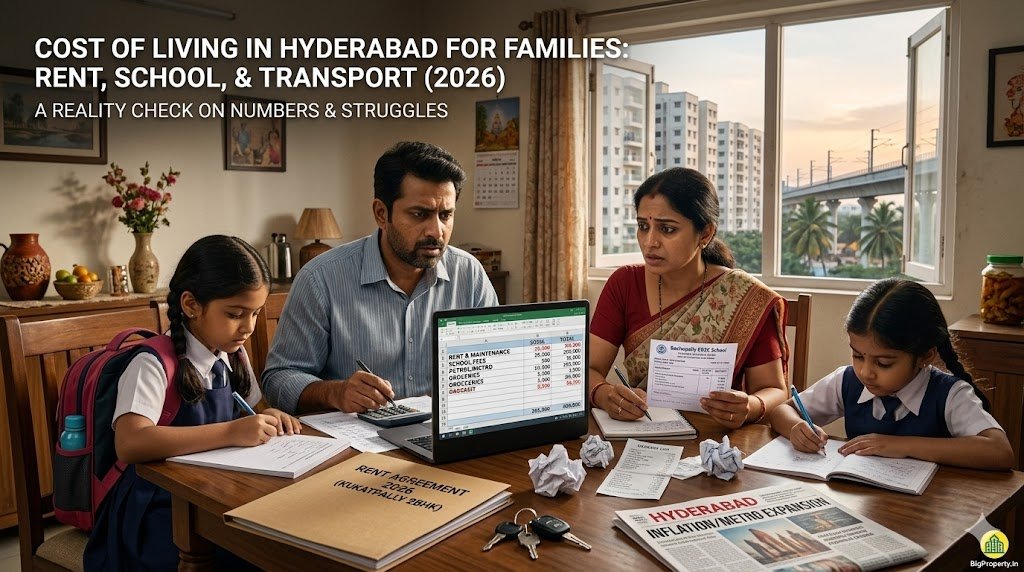
March is arguably the most stressful month of the year for a middle-class family in Hyderabad.
Imagine this very real scenario: You are a 38-year-old professional living with your family in a rented 2BHK in a bustling area like Kukatpally. Your two daughters (perhaps around 10 and 7 years old) are just finishing their final academic term. You are already calculating how to manage the upcoming academic year’s expenses when your landlord drops a bombshell—he asks you to vacate the house by the end of the month.
Suddenly, the financial walls close in. You need to hunt for a new rental, arrange a massive security deposit, manage the physical cost of shifting, and somehow prepare for the April school fee hikes. The financial pressure is so suffocating that many households are only surviving today because partners are stepping up—starting small home-based businesses, perhaps making traditional snacks or pickles, just to keep the family ship afloat and clear the mounting bills.
Must Read: This article is part of our Resale Property vs. New Launch in Hyderabad: Which is Actually Cheaper in 2026? (A Reality Check). If you are tired of the rental trap and want to buy your own home, read our guide on how to compare properties first.
If you are planning your family finances, or if you are an NRI planning to return to Hyderabad, throw away the old Google searches from 2022. Here is the absolute, unvarnished reality of what it costs to raise a family in Hyderabad in 2026.
1. The Rental Nightmare: The “2-Month Deposit” Scramble
Just three years ago, areas like Kukatpally, Miyapur, or Nizampet were considered the “budget-friendly” havens for IT employees and business owners. Not anymore.
The 2026 Math:
- A standard 2BHK (Older Building): ₹22,000 to ₹26,000 per month.
- A standard 3BHK (Gated Community): ₹35,000 to ₹45,000 per month.
- Maintenance: Add an inescapable ₹3,000 to ₹5,000 on top of the rent.
But the real crisis isn’t just the monthly rent; it is the forced relocation. Landlords in 2026 are frequently turning over tenants to hike the rent by 15-20% for the next family. When you are asked to vacate, you aren’t just paying rent for the next month. You are suddenly forced to come up with ₹60,000 to ₹80,000 as a new security deposit, plus ₹10,000 for Packers & Movers. For a family already managing tight debts or cash-flow issues, this single event can wipe out an entire year of savings.
2. The “Silent EMI”: The Brutal Reality of School Fees
If you have two school-going children, you already know that education in Hyderabad has become a luxury expense, rivaling a luxury car EMI.
Let’s look at standard CBSE schools (not the ultra-elite international schools in Gachibowli, but regular, good-quality schools in the Kukatpally/Bachupally belt).
The Breakdown (For Two Children – e.g., 5th Grade & 2nd Grade):
- Annual Tuition Fees: ₹1,00,000 to ₹1,40,000 per child.
- Transport (School Bus): ₹35,000 to ₹45,000 per child (Yes, bus fees have skyrocketed due to fuel costs).
- Books, Uniforms & “Activities”: ₹15,000 to ₹20,000 per child.
Total Annual Cost for 2 Kids: Easily touching ₹3,00,000 to ₹3,50,000 a year. When broken down, that is a mandatory “Silent EMI” of ₹25,000 to ₹30,000 every single month just for basic education.
This is exactly why the single-income household is slowly dying in Hyderabad. Managing this educational burden on one salary is nearly impossible without accumulating debt, pushing families to find secondary income streams, freelance work, or home businesses just to fund their children’s future.
3. The Commute: Fuel, Traffic, and the 10-Year-Old Hatchback
Let’s talk about getting to work. If you are holding onto a trusty 10-year-old hatchback (like a 2016 model) to avoid buying a new car on EMI, you are making a smart financial choice. But the daily running costs are still bleeding your wallet.
In 2026, the commute from a residential hub to an office in Hitech City or the Financial District is brutal.
- By Car: A daily 30-40 km round trip in bumper-to-bumper traffic gives terrible mileage. You are looking at a petrol bill of ₹6,000 to ₹8,000 per month, plus the inevitable ₹1,500 for office parking and occasional maintenance.
- By Metro: The Metro is a lifesaver for time, but for a family, it isn’t always cheap. A monthly Metro pass might cost ₹2,500, but “last-mile connectivity” (taking an auto from the station to your office or home) easily adds another ₹2,000.
- Family Outings: Taking the family out on a weekend? Just the fuel and parking for a mall visit will set you back ₹500 before you even buy a single item.
The Reality: Transportation is no longer a small line item. It is a major chunk of your monthly budget, averaging ₹7,000+ just to move around the city.
4. Groceries, Utilities, & The Summer Electricity Shock
We don’t need to look at luxury dining; let’s just look at the cost of keeping the kitchen running and the lights on for a family of four.
- Groceries & Provisions: Rice, pulses, cooking oil, fresh vegetables, and daily milk. Even with strict budgeting and buying from local markets instead of premium supermarkets, a family of four spends ₹12,000 to ₹15,000 monthly.
- Utilities (The March/April Shock): As summer hits, electricity bills skyrocket. A 2BHK running an AC at night will easily pull a ₹2,500 to ₹4,000 power bill.
- The “Basics”: Add a cooking gas cylinder, a reliable broadband connection (essential for remote work or kids’ projects), and mobile recharges for two adults. That is another ₹3,000.
There is zero room for error here. One medical emergency or one unexpected car repair, and the entire month’s budget collapses.
Related Article: Top 10 Gated Community Villa Projects in Hyderabad Under ₹2 Crore (2026 List)
5. The Final 2026 Monthly Budget (The “Survival” Math)
Let’s put it all together. This is the baseline cost for a middle-class family of four living in a standard 2BHK in Hyderabad, sending two kids to a decent school, and commuting to work.
| Expense Category | Monthly Cost (Approx.) |
| Rent & Maintenance (2BHK) | ₹25,000 |
| School Fees & Bus (Pro-rated for 2 Kids) | ₹25,000 |
| Groceries & Household Supplies | ₹15,000 |
| Transport / Fuel | ₹7,000 |
| Utilities (Electricity, Gas, Internet) | ₹5,000 |
| Miscellaneous (Medicines, Minor Outings) | ₹5,000 |
| Total Mandatory Expenses | ₹82,000 / Month |
Notice what is missing from this table? There are no EMIs for personal loans, no vacations, no major shopping, and zero savings.
If your take-home salary is ₹80,000 to ₹1,00,000, you are merely surviving the city, not building wealth in it.
The Escape Plan: Why Renting is the Ultimate Trap
When you are paying ₹25,000 a month in rent, you are paying your landlord’s EMI. At the end of 5 years, you will have paid ₹15 Lakhs in rent, and you will still own nothing. And as we discussed earlier, you can still be asked to vacate with a month’s notice.
This is exactly why smart families are shifting their strategy. Instead of bleeding ₹25,000 on rent in Kukatpally, they are buying budget-friendly DTCP/HMDA plots in developing corridors like Shadnagar or Shankarpally, building a modest home, and securing their family’s future. An EMI builds an asset; rent just builds anxiety.

