
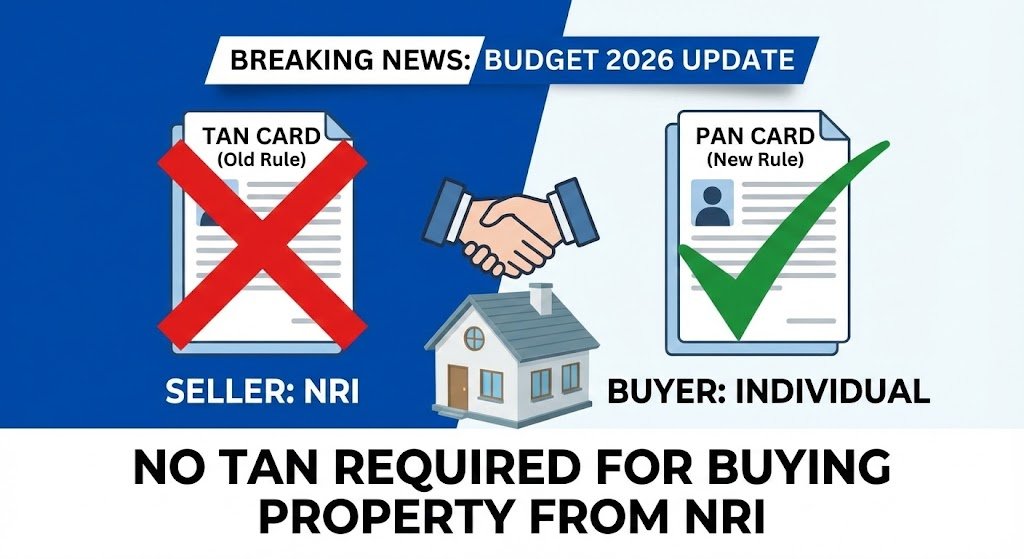
If you are planning to buy a property from a Non-Resident Indian (NRI) in 2026, the biggest headache used to be the TAN (Tax Deduction and Collection Account Number) requirement.
Previously, if you bought a house from an NRI, you (the buyer) had to apply for a TAN number just to deduct TDS. It was a complex process that scared away many local buyers.
Good News: In the recent Budget 2024-25 (and continued in 2026), the government has simplified this rule.
This article is part of our Ultimate NRI Real Estate Investment Guide 2026 series. If you missed the full guide on FEMA rules and best cities, read it here first.
In this detailed update, we explain the New TDS Rules 2026 for buying property from NRIs, why you no longer need a TAN in specific cases, and how to file Form 26QE without a CA’s help.
The Old Rule vs. The New Rule (2026)
To understand the relief, you must understand the pain of the old system.
The Old Rule (Before July 2024):
- If you bought a property from a Resident Indian (Value > ₹50 Lakhs), you deducted 1% TDS using your PAN Card. Easy.
- If you bought from an NRI, you had to deduct 20% TDS. But to pay this to the government, you were forced to apply for a TAN Number.
- Problem: A common home buyer is not a business. Why should they apply for a TAN?
The New Rule (Effective Now):
- No TAN Required: If you are buying a property from an NRI, you can now deduct and deposit the TDS using just your PAN Card.
- The Condition: This relaxation applies only if the property is purchased for personal use (not for business/commercial trading) and you are an Individual/HUF.
- The Form: You will now use Form 26QE (Statement of TDS on payment to non-resident) instead of the complex Form 27Q.
Must Read: Navigating Legalities: A Comprehensive Guide to NRIs Buying Property in India
When is TAN Still Mandatory? (Don’t Get Fined!)
While the rule has been relaxed for most home buyers, there is a catch. You STILL NEED A TAN if:
- Commercial Property: You are buying the property for your business (e.g., office space, factory land).
- Company Purchase: The buyer is a “Private Limited Company” or “Partnership Firm” (not an Individual).
- Seller is Foreign Citizen: If the seller is not an NRI but a foreign citizen (Non-OCI holder), stricter FEMA rules might apply.
Simple Rule of Thumb:
- Buying a Flat/Plot for yourself? → No TAN (Use PAN Only).
- Buying a Shop for your business? → TAN Required.
How to File TDS (Form 26QE) Without a CA
Previously, buyers needed a Chartered Accountant (CA) to file Form 27Q because it required a TAN login. Now, you can do it yourself in 15 minutes.
The Step-by-Step Process (2026):
- Login to E-Filing Portal: Go to the Income Tax India website and log in using your PAN Card.
- Select Form 26QE: Under “e-Pay Tax,” look for the new option: “TDS on Property (Form 26QE)”.
- Fill Seller Details: Enter the NRI Seller’s Name, PAN Number, and Address.
- Enter Payment Details:
- Date of Payment: The day you transferred money to the seller.
- TDS Rate: Select “20% + Surcharge + Cess” (Auto-calculated).
- Pay Online: You can pay the TDS amount via Net Banking or UPI.
- Download Certificate: After 5-7 days, download Form 16E (TDS Certificate) and email it to the NRI seller. They need this to claim their tax refund.
Must Read: Tax Deducted at Source: All About TDS Meaning, Filing & Return
The “1% vs. 20%” Confusion: Which One Applies?
Many buyers are still confused. “My friend paid only 1% TDS. Why are you asking me to pay 20%?”
Here is the clear distinction for 2026:
| Feature | Buying from Resident Indian | Buying from NRI |
| TDS Rate | 1% | 20% (Plus Surcharge & Cess) |
| Threshold | Only if value > ₹50 Lakhs | Start from ₹1 (No limit) |
| Form to Use | Form 26QB | Form 26QE (New!) |
| TAN Required? | No | No (New Rule!) |
The Risk: If you wrongly deduct only 1% for an NRI seller, the Income Tax Department will send YOU a notice to pay the remaining 19% + Interest + Penalty. Always verify the Residency Status of the seller in the sale deed.
Final Verdict: A Huge Relief for Home Buyers
This change in the Finance Act is a game-changer for the real estate market in Hyderabad and Bangalore, where many sellers are NRIs.
- For Buyers: You save ₹15,000 (CA fees for TAN application and filing). The process is now as simple as paying your electricity bill.
- For NRI Sellers: It is easier to find buyers now because the “TAN Fear” is gone.
Advice: Even though the process is online, always double-check the PAN Number of the seller. If the PAN is inoperative, the TDS rate jumps to 40%.
Must Read: Unlocking Opportunities: Top Cities in India for NRI Real Estate Investment
FAQs: No TAN for NRI Property Purchase
No. As per the new amendment (Finance Act 2024-25), Individuals and HUFs buying property for personal use do not need a TAN. You can deduct TDS using your PAN card via Form 26QE.
The base rate is 20%. However, you must add Surcharge and Health & Education Cess. The effective rate usually comes to 20.8% to 23.92% depending on the property value.
No. TDS must be deducted at the time of payment to the seller. You must deposit it to the government within 30 days from the end of the month in which deduction is made. (e.g., If you pay seller on Feb 10th, pay TDS by March 30th).
You (the buyer) are liable. The Income Tax Department will recover the unpaid tax amount from you, plus an interest of 1.5% per month for the delay.
No. Form 26QB is strictly for buying from Resident Indians. If the seller is an NRI, you MUST use Form 26QE. Using the wrong form is a compliance error.
Must Read:
ITR Made Simple: A Step-by-Step Guide to Filing Your Income Tax Return
How to Get Plot Loans in Hyderabad?
Best banks for land loan
NRI Guide for Investment in india

, Form 26QE process, and TDS rates.)